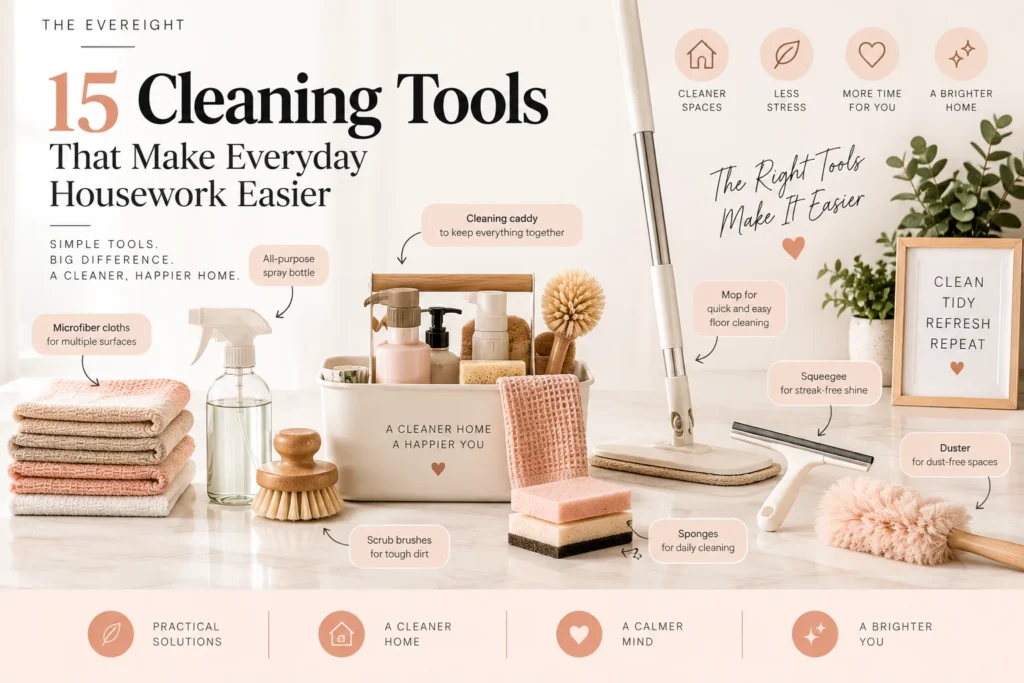
Affiliate disclosure: As an Amazon Associate, The EverEight earns from qualifying purchases.
The best cleaning tools do not create more chores. They reduce repeated effort, reach the surfaces you actually have, and make routine cleaning easier to start and finish.
That does not mean every home needs a closet full of gadgets. A compact set of versatile tools is usually more useful than a collection of highly specialized products. The right choices depend on your flooring, furniture, household size, storage, pets, and the kinds of mess you deal with most often.
This guide covers 15 categories that can genuinely improve everyday housework. It focuses on function rather than brands because product specifications and availability change. Before buying a specific model, verify its current dimensions, materials, care instructions, compatibility, and manufacturer guidance.
Quick Verdict
For most homes, the highest-value starting set is a suitable vacuum or floor tool, washable cleaning cloths, a scrub brush, a squeegee where appropriate, a duster or vacuum attachment for accessible dust, a cleaning caddy, and a mop system compatible with the flooring.
Add specialty tools only when a recurring problem justifies them.
1. A Vacuum That Fits Your Flooring and Home
A vacuum can be one of the biggest time savers in a home, but only if it matches the surfaces and layout.
For carpet, check whether the machine is designed for the carpet type. For hard floors, look for a head or setting that handles debris without damaging the surface. If you have stairs, consider weight and hose reach. Pet households may value hair-management attachments.
Cordless models can reduce setup friction, while corded machines may offer different runtime and performance characteristics. Neither format is automatically better.
What to check before buying
Verify supported floor types, weight, filtration information, runtime if battery-powered, charging time, replacement filters or bags, attachment compatibility, and warranty.
Do not rely on marketing language alone for allergy or filtration claims.
2. Microfiber or Other Suitable Washable Cleaning Cloths
Product to compare: MR.SIGA Microfiber Cleaning Cloths — Reusable cloths for everyday wiping and dusting. View on Amazon.
Reusable cloths are useful for dusting, wiping, drying, and many routine cleaning tasks.
Microfiber is popular because its fine fibers can pick up dust effectively, but it is not the only option. The best cloth depends on the surface and cleaning method.
Use separate cloths or a clear hygiene system for areas where cross-contamination matters. Launder reusable cloths according to their care instructions.
What to look for
Choose a manageable size, durable stitching, and a texture appropriate for the surfaces you clean. Avoid using an abrasive cloth on a delicate finish.
3. A Comfortable Scrub Brush
Product to compare: Amazon Basics All-Purpose Rectangular Scrub Brush — For suitable durable surfaces; test delicate finishes first. View on Amazon.
A hand scrub brush provides controlled mechanical action for suitable sinks, tubs, tile, utility areas, and other washable surfaces.
The handle should be comfortable when wet, and the bristles should match the surface. Stiff bristles can damage delicate finishes.
A smaller detail brush can be useful for edges and tight areas, but you do not need a separate brush for every task.
4. A Floor Mop Appropriate for Your Floor
Product to compare: Bona Premium Mop — Check compatibility with your floor type and cleaning solution. View on Amazon.
There is no universal best mop.
Some hard floors tolerate damp cleaning; others require very limited moisture or specific products. Follow the flooring manufacturer’s care instructions.
A flat mop with washable pads can be easy to store and maneuver. Other homes may prefer a traditional mop system or a spray-style tool.
What matters most
Check the recommended cleaning method for your floor before choosing the tool. A convenient mop that uses too much moisture is not a good purchase for a moisture-sensitive surface.
5. A Squeegee for Appropriate Smooth Surfaces
A squeegee can quickly remove water from suitable shower glass, tile, mirrors, or windows.
Its value comes from speed: one pass can move more water than repeated wiping.
Choose a blade width that fits the surface and a handle that is comfortable to grip. Store it where it can dry.
A squeegee is less useful if your home has very few suitable smooth surfaces.
6. A Duster With Reach
Product to compare: BOOMJOY Extendable Duster — For safely accessible higher or awkward areas. View on Amazon.
Dust on safely accessible higher surfaces is easier to manage with a lightweight extendable tool than with unsafe climbing.
Look for a head that can be cleaned or replaced and a handle that locks securely.
An extendable duster does not make every high area safe to reach. Avoid working near electrical hazards, unstable objects, or areas requiring a ladder beyond your ability to use safely.
7. A Vacuum Crevice Tool
Small attachments are easy to underestimate.
A crevice tool can reach along baseboards, between cushions, around certain appliance edges, and in narrow areas that a floor head cannot access.
Before buying a separate accessory, check what came with your vacuum and whether replacement or compatible attachments are available from the manufacturer.
8. A Cleaning Caddy
Product to compare: Casabella Cleaning Caddy — Keeps frequently used supplies together between rooms. View on Amazon.
A caddy reduces trips for supplies and makes it easier to return products to storage when the job is finished.
Choose one that is light enough to carry when full, has a stable handle, and fits your actual cleaning products.
Do not use portability as a reason to leave chemicals accessible. Return products to safe storage after cleaning and follow label instructions regarding children and pets.
9. A Small Dustpan and Brush
For a handful of crumbs, soil, or broken dry debris, taking out a full-size vacuum may be unnecessary.
A compact dustpan and brush can handle quick kitchen and entryway messes.
Choose a dustpan edge that sits reasonably flat against the floor and a brush that stores neatly with it.
For broken glass or hazardous debris, use an appropriate safe cleanup method rather than handling fragments directly.
10. A Grout or Detail Brush
A narrow brush can make edges, seams, and suitable grout lines easier to address.
The important word is suitable. Aggressive brushing can damage sealants, soft materials, or deteriorated surfaces.
Use a detail brush when a normal cloth cannot physically reach the area, not because every corner needs intense scrubbing.
11. A Reusable Lint or Pet-Hair Tool
Pet hair and lint can create repeated work on upholstery and clothing.
Depending on the material, a reusable lint brush, rubber-style hair tool, or appropriate vacuum attachment may reduce disposable-sheet use.
Check upholstery care instructions before using any friction-based tool. Test in an inconspicuous area if the material is delicate.
12. A Long-Handled Cleaning Brush
A long handle can reduce bending for suitable tubs, showers, or floors.
It is particularly useful when the tool head can pivot into the required angle without forcing the user into an awkward position.
Choose a stable handle and a head appropriate for the surface. Do not apply excessive force simply because the longer handle provides leverage.
13. A Window or Glass-Cleaning Tool
For homes with substantial glass, a dedicated washer-and-squeegee combination can be more efficient than many paper towels or cloths.
Indoor windows, mirrors, and accessible glass can often be handled with simple tools.
Exterior upper-story windows introduce fall risk and may require professional service or specialized safe equipment. A cleaning tool does not make unsafe access acceptable.
14. A Bucket With a Practical Shape
A basic bucket remains useful for carrying water where appropriate, soaking washable tools, or supporting certain floor-cleaning systems.
Look for a comfortable handle, stable base, and size you can safely lift when filled.
Remember that water is heavy. A very large bucket may create unnecessary lifting risk.
Never use an unlabeled cleaning bucket to store food or drinking water.
15. A Small Handheld Vacuum – If It Solves a Repeated Problem
A handheld vacuum can be useful for stairs, cars, upholstery crumbs, small dry spills, or quick pet-hair cleanup.
It is not essential if your main vacuum already handles those tasks conveniently.
Before buying, compare runtime, charging, weight, bin emptying, filtration, and attachment options. The tool earns its space only if it gets used more often than it needs charging, cleaning, and storing.
Which Cleaning Tools Are Worth Buying First?
If you are starting from almost nothing, prioritize tools by frequency.
First: a floor-cleaning system suitable for your surfaces.
Second: reusable cloths and a basic scrub brush.
Third: a portable way to carry supplies and a tool for quick debris.
Then: add reach, detail, glass, pet-hair, or handheld tools according to your home’s actual friction points.
This sequence prevents a beginner from spending heavily on specialty tools while missing the basics.
Cleaning Tools You May Not Need
Single-purpose gadgets for rare jobs
If a tool solves a problem you encounter twice a year, borrowing, renting, or using an existing tool may be better.
Oversized tool sets
Sets can look economical while including brushes and attachments you never use.
Duplicate powered cleaners
A second powered tool should solve a clear limitation of the first. Otherwise, you gain charging, maintenance, and storage work.
Tools that are difficult to clean
A cleaning tool becomes unhygienic or unpleasant if hair, residue, or dirty water cannot be removed easily.
Tools that do not fit your storage
Measure the closet, cabinet, or wall space before buying long handles or bulky machines.
Cordless vs Manual Cleaning Tools
Powered tools can reduce effort for some jobs, but they introduce batteries, charging, replacement parts, and maintenance.
Manual tools are usually simpler, cheaper, and easier to store.
Ask whether power materially improves a recurring task. A cordless vacuum used every day may be valuable. A powered scrubber for one tiny monthly job may not be.
Reusable vs Disposable Tools
Reusable cloths, washable mop pads, and durable brushes can reduce ongoing purchases, but they require proper cleaning and drying.
Disposable products may be appropriate in specific situations where hygiene or contamination concerns make reuse impractical.
The better choice depends on the task. Do not assume reusable always means more hygienic, or disposable always means more effective.
How to Evaluate a Cleaning Tool Before Buying
Ask:
- What recurring task does this improve?
- Is it safe for my surfaces?
- Can I comfortably lift and use it?
- How will I clean the tool itself?
- Where will I store it?
- Does it require consumables or replacement parts?
- Are those parts readily available?
- Will I use it often enough to justify its footprint?
- Could an existing tool already do the job?
These questions are more useful than a long feature list.
Cleaning Tool Safety Basics
Read the tool and cleaning-product instructions.
Keep electrical cleaning equipment away from water unless specifically designed for that use. Inspect cords, batteries, handles, and attachments for damage. Do not use powered equipment with damaged electrical components.
Use stable access methods for elevated areas and avoid unsafe reaching.
Store sharp, chemical, powered, or otherwise hazardous items appropriately and away from children and pets.
Editorial Note
Our buying guides are based on independent research and practical evaluation criteria. We aim to provide accurate, useful information that helps readers make informed decisions. Product specifications, prices, availability, warranties, and manufacturer guidance can change, so verify current information before purchasing.
EverEight Pro Tip
Before buying a new cleaning tool, keep a one-week “friction list.” Each time cleaning feels unnecessarily difficult, write down why. Buy only for problems that appear repeatedly. This turns shopping into a response to evidence instead of advertising.