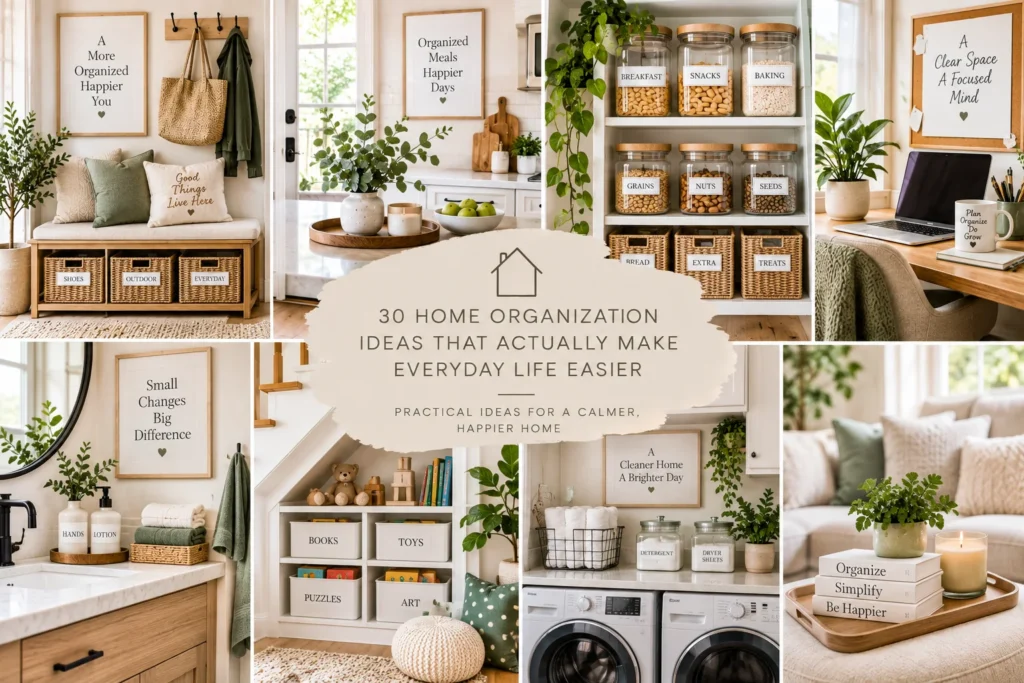
The best home organization ideas are not necessarily the prettiest ones. They are the systems that quietly remove friction from ordinary days: keys are where you expect them, clean towels have enough space, lunch supplies are easy to grab, and the things you use together are stored together.
The following 30 ideas focus on function first. You do not need to implement all of them. Choose the problems that repeatedly slow your household down and test a few changes at a time.
1. Create a Real Landing Zone by the Door
Give everyday arrivals a destination. A small tray for keys, hooks for bags, and a defined shoe area can stop clutter before it travels through the house.
Keep the landing zone limited. It should hold current-use items, not become long-term storage for every jacket and pair of shoes.
2. Put Storage Where Clutter Naturally Appears
If objects repeatedly collect in the same place, study why. A basket beside the stairs can hold items waiting to go upstairs. A hook near the sofa can hold headphones. A hamper where clothes are actually removed is more useful than one placed where you think it should look best.
Work with behavior whenever possible.
3. Give Frequently Used Items the Best Storage
Prime storage means the easiest shelves, drawers, and cabinets. Reserve it for things used daily or weekly.
Holiday serving pieces do not need the easiest kitchen cabinet. Everyday plates do.
4. Use Broad Categories Instead of Tiny Ones
Overly detailed systems take more effort to maintain. “School supplies” may work better than separate bins for pencils, erasers, rulers, sharpeners, and markers.
Create subcategories only when finding an item inside the broader category is genuinely difficult.
5. Add Drawer Dividers Where Small Items Drift
Dividers are especially useful for cutlery, office supplies, cosmetics, tools, and junk drawers.
Measure first. Choose a layout based on what is actually in the drawer rather than forcing possessions into a preselected organizer.
6. Create a Backstock Zone
Extra toiletries, cleaning supplies, and pantry staples can overwhelm everyday storage.
Choose one location for unopened backstock. When the daily-use item runs out, shop your backstock before adding it to the grocery list.
7. Use a “First Here” Basket for Items That Belong Elsewhere
A small basket can temporarily collect objects that need to move to another floor or room.
The important word is temporarily. Empty it during a daily or weekly reset so it does not become a permanent miscellaneous bin.
8. Organize the Pantry Around Meals and Habits
Instead of copying someone else’s labels, group food according to how you cook: breakfast, lunch-building, snacks, baking, grains, canned goods, or quick dinners.
A system that matches your meal routine reduces searching and makes grocery planning easier.
9. Create an Eat-First Food Area
Designate a small refrigerator or pantry area for foods that should be used soon.
This makes leftovers, ripe produce, and opened packages more visible and can help reduce food waste.
10. Store Food Containers With Their Lids
Choose a method that prevents the familiar avalanche of unmatched lids. Nest compatible containers and keep lids upright in a divider, or store lids with containers if space allows.
Periodically remove damaged and permanently unmatched pieces.
11. Keep Cooking Tools Near Their Point of Use
Store spatulas near the stove, knives near the preparation area, and food-storage supplies near the place where leftovers are packed.
Reducing unnecessary movement makes the kitchen feel more efficient even if you do not add any storage.
12. Use Vertical Cabinet Space
Shelf risers can turn one tall cabinet shelf into two usable levels. This is especially helpful for plates, mugs, cans, and small pantry items.
Do not stack heavy or unstable objects where retrieving them becomes unsafe.
13. Create a Simple Cleaning Caddy
Keep frequently used cleaning supplies together in a portable caddy if that suits your home.
Do not mix chemicals or transfer products into unlabelled containers. Follow product instructions and store cleaning products safely away from children and pets.
14. Keep a Small Set of Cleaning Supplies Near High-Use Areas
In a multi-level home, carrying every cleaning item from one central location can add friction. A safe, appropriately stored mini set in a bathroom or upstairs area may make quick cleaning easier.
Only duplicate products you actually use.
15. Give Laundry a Complete Workflow
Think beyond the hamper. Where do dirty clothes go? Where are stain-treatment items? Where do clothes wait to be folded? Where do items needing repair go?
Closing gaps in the workflow prevents laundry from becoming a series of piles.
16. Add a “Wear Again” Spot
Clothes that are not freshly clean but are not ready for washing often end up on chairs.
A dedicated hook, rail, or small section of the closet gives these items a legitimate home and keeps them off furniture.
17. Store Complete Bedding Sets Together
Keep matching pillowcases and sheets together so you do not search several shelves when changing the bed.
One method is to fold a set together or place smaller pieces inside a pillowcase. Use whichever system is easiest for you to maintain.
18. Limit the Nightstand to Nighttime Needs
Nightstands become clutter magnets because they are convenient surfaces.
Keep the items you genuinely use before sleep or after waking, and relocate unrelated paperwork, chargers, cosmetics, and random objects.
19. Create a Morning-Ready Zone
Group the items needed to leave the house: work bag, school materials, keys, reusable bottles, or items that must go with you the next day.
Preparing this zone in the evening can reduce morning searching.
20. Use Hooks for Things That Never Make It Onto Hangers
A theoretically perfect closet system is useless if nobody follows it.
Hooks are fast for robes, bags, hats, frequently worn jackets, and other light items. Install them securely and at a useful height.
21. Give Paperwork an Action Home
Do not file a bill or form that still requires action.
Use a small tray or folder for papers that need payment, signatures, calls, filing, or follow-up. Review it on a regular schedule.
22. Separate Reference Papers From Action Papers
Reference documents are kept because you may need the information later. Action papers represent unfinished tasks.
Separating them makes both categories easier to manage and prevents important tasks from disappearing inside filing.
23. Create a Charging Station
Choose one practical location for regularly charged devices and their cables.
Cable labels can help when several chargers look alike. Avoid overloaded outlets and use charging equipment according to manufacturer guidance.
24. Create a Home for Cables and Small Electronics
Sort spare cables by type or device rather than throwing all of them into one box.
Label unfamiliar cables before you forget what they belong to. Recycle obsolete electronics responsibly instead of storing them indefinitely.
25. Keep Everyday Office Supplies Within Reach
Your desk should support work, not display your entire stationery collection.
Keep the small set used regularly nearby and store extras elsewhere. A clearer work surface can reduce visual distraction.
26. Use Simple Toy Categories
For children, broad visible categories make cleanup easier: blocks, cars, dolls, art, puzzles, or stuffed animals.
Labels with pictures can help younger children participate. Keep storage physically safe and accessible for the child using it.
27. Rotate Toys Instead of Storing Everything in the Play Area
If too many toys make play and cleanup difficult, store part of the collection elsewhere and rotate it periodically.
Rotation can make familiar toys feel interesting again while reducing the amount that needs to be managed at one time.
28. Label Closed Storage
Labels are most useful when you cannot see what is inside.
Be specific enough to help – “extension cords” is better than “misc.” – but not so specific that every object needs its own category.
29. Create a Donation Exit Point
Choose one bag, basket, or box for items you decide to donate.
When it is full, move it out of the house promptly. This turns decluttering into an ongoing habit rather than an occasional major event.
30. Schedule a 10-Minute Reset Around Your Highest-Friction Area
Do not attempt to reset the entire house every evening. Choose the area that affects tomorrow most: kitchen counters, entryway, living room, or work desk.
Ten focused minutes can restore function without turning every evening into a cleaning session.
How to Choose Which Ideas to Implement
Start with friction, not aesthetics. Identify three moments when you regularly think, “Why is this always here?” or “Why can I never find this?”
Choose one organization idea that directly addresses each problem. Test it with items you already own before purchasing a permanent organizer.
After a week or two, evaluate whether the system is being used naturally. If not, adjust the location, category, or amount stored.
What Organization Products Are Actually Useful?
Useful products tend to solve one of four problems: separating small items, improving access, using vertical space, or containing a defined category.
Drawer dividers, shelf risers, hooks, baskets, and turntables can be excellent tools when matched to the right problem. None is automatically necessary.
Measure carefully, especially inside cabinets. A product that technically fits may still prevent a door from closing or reduce access to plumbing, outlets, or ventilation.
Common Mistakes to Avoid
Do not buy a full set of matching containers before you know what needs to be stored. Avoid hiding everyday items simply to create empty-looking surfaces. Do not create complicated labels that require too much sorting.
Most importantly, do not confuse more storage with less clutter. Sometimes the correct organization solution is to own fewer objects in that category.
EverEight Pro Tip
For one week, put a sticky note wherever you repeatedly search for, drop, or move an item. At the end of the week, those notes become a personalized organization plan based on real household friction rather than generic inspiration.