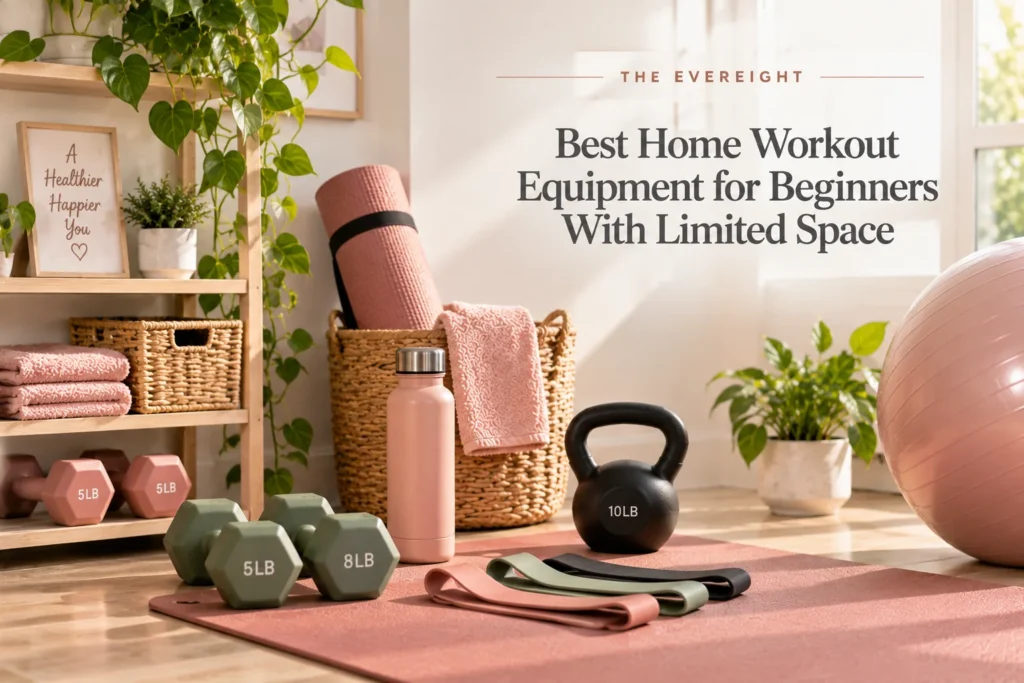
A beginner home gym does not need to look like a commercial fitness center.
For most people with limited space, the best equipment is compact, easy to use, versatile enough for several movements, and capable of becoming more challenging as fitness improves. A large machine that becomes a clothes rack is worse value than one resistance tool you use consistently.
This buying guide is category-first. It explains what types of equipment are worth considering and how to compare them. It does not rank current models, quote temporary prices, or claim hands-on testing. Product specifications and availability change, so verify manufacturer information before buying.
Quick Verdict
Start with the minimum equipment that solves your current training limitation. For many beginners, that means a comfortable exercise mat if floor work is part of the routine and either resistance bands or a manageable pair of dumbbells. Add adjustable resistance, a stable bench or compact cardio equipment only after your routine shows a genuine need.
Before You Buy Anything
Answer five questions:
- What exercises will I actually perform?
- How much floor and storage space do I have?
- What resistance can I safely control now?
- How will the equipment become harder as I improve?
- Can I use it safely without permanent installation?
Equipment should support a program, not replace one.
Category 1: Exercise Mat
Best for
Floor exercises, mobility work, kneeling movements and creating a defined workout area.
What to compare
Consider:
- Dimensions.
- Thickness.
- Surface grip.
- Firmness.
- Material and odor sensitivity.
- Cleaning instructions.
- Storage method.
A very thick, soft mat may feel comfortable for lying down but can be less stable for standing exercises.
Who can skip it
If your routine is entirely standing or you already have an appropriate non-slip surface, a dedicated mat may be unnecessary.
Category 2: Loop Resistance Bands
Small loop bands are compact and inexpensive.
They can be used for certain hip, leg, shoulder and accessory exercises.
What to compare
Look at:
- Resistance levels.
- Material.
- Dimensions.
- Whether bands roll or pinch for your intended use.
- Manufacturer inspection and replacement guidance.
Fabric and elastic designs feel different. Neither is automatically superior.
Limitations
Small loops do not replace every pulling, pressing or lower-body exercise.
They are one tool, not a complete gym.
Category 3: Long Resistance Bands
Long bands can support rows, presses, assisted movements and many full-body exercises.
Why they work in small spaces
They store in a drawer or bag and provide multiple resistance levels.
Safety matters
Bands can fail if damaged or anchored poorly.
Inspect them before use.
Use only secure anchoring methods specified for the product.
Never attach a band to lightweight furniture or an improvised object that could move, break or become a projectile.
Category 4: Resistance Tubes With Handles
Tubes with handles can feel more familiar than flat bands.
Some systems include door anchors.
What to compare
Verify:
- Anchor instructions.
- Door orientation and suitability.
- Resistance labeling.
- Handle construction.
- Tube condition.
- Replacement guidance.
Do not assume every door is an appropriate anchor.
Follow the manufacturer’s instructions exactly.
Category 5: Fixed Dumbbells
Dumbbells are straightforward and versatile.
They can train:
- Squats.
- Hinges.
- Rows.
- Presses.
- Carries.
- Arm and shoulder exercises.
Advantages
No adjustment mechanism.
Easy to pick up and use.
Disadvantages
Multiple pairs require more storage as strength improves.
Buying approach
Beginners do not need a complete rack.
If one or two pairs match your current exercises, start there.
Category 6: Adjustable Dumbbells
Adjustable dumbbells combine multiple resistance settings in a smaller footprint.
Why they can be good value
They may replace several fixed pairs.
What to compare
Verify:
- Available resistance range.
- Increment sizes.
- Handle dimensions.
- Adjustment mechanism.
- Locking system.
- Length at lighter settings.
- Storage cradle requirements.
- Manufacturer restrictions on dropping.
Important limitation
Some adjustable systems are bulky or delicate.
A compact footprint does not automatically mean they feel compact during every exercise.
Category 7: A Single Kettlebell
A kettlebell can be useful for squats, hinges, carries and other exercises.
However, ballistic exercises such as swings require technique and are not mandatory for beginners.
Who it suits
Someone who has a specific kettlebell-based program and understands how the tool will be used.
Who should skip it initially
A beginner buying equipment before choosing exercises may get more versatility from dumbbells or bands.
Category 8: Adjustable Kettlebell
An adjustable kettlebell can save storage space.
Compare:
- Resistance range.
- Adjustment security.
- Handle clearance.
- Shape at different settings.
- Manufacturer guidance for dynamic movements.
Not every adjustable design is intended to be dropped or used identically to a solid kettlebell.
Category 9: Step or Low Platform
A stable exercise step can support step-ups and selected lower-body exercises.
What matters
Verify:
- Weight capacity.
- Platform dimensions.
- Surface grip.
- Height options.
- Stability.
- Floor compatibility.
A household stool is not automatically a safe substitute.
Category 10: Compact Weight Bench
A bench can expand dumbbell exercise options.
But it takes meaningful floor space.
Consider one when
You already train consistently and need supported or lying exercises that are awkward on the floor.
Compare
- Footprint.
- Folded dimensions if foldable.
- Weight capacity.
- Stability.
- Adjustment positions.
- Assembly.
- Floor protection.
Do not choose solely because a bench folds. It must remain stable in use.
Category 11: Suspension Trainer
Suspension systems can provide scalable body-weight resistance.
They require a secure, manufacturer-approved anchor.
Strengths
Compact storage and many exercise variations.
Cautions
Anchor safety is critical.
Exercise difficulty changes substantially with body angle.
Beginners may benefit from instruction.
Category 12: Pull-Up Bar
Pull-up bars are popular but not essential.
Pull-ups can be difficult for beginners, and mounting methods vary.
Before buying
Verify:
- Doorframe or wall compatibility.
- Installation requirements.
- Weight capacity.
- Clearance.
- Building restrictions.
- Manufacturer instructions.
Do not assume a doorway can safely support a bar.
Category 13: Compact Cardio Equipment
Examples can include walking pads, folding treadmills, compact bikes or steppers.
These can be useful when weather, safety or schedule makes outdoor activity difficult.
What to compare
For any motorized or mechanical cardio equipment, verify:
- User weight capacity.
- Speed or resistance range.
- Usable deck or pedal dimensions.
- Handrail configuration.
- Folded and operating footprint.
- Electrical requirements.
- Noise.
- Warranty.
- Maintenance.
- Safety features.
Current specifications must come from the manufacturer.
Walking Pad vs Treadmill
A walking pad may store more easily but can have a different speed range, deck size, controls and support structure than a conventional treadmill.
A full treadmill may provide more options but requires more space.
Choose based on actual walking needs, not social-media aesthetics.
Exercise Bike
A compact stationary bike can provide low-impact aerobic exercise for many users.
Fit matters.
Compare seat adjustment, pedal position, stability and resistance.
People with significant joint, balance or cardiovascular concerns may need individualized exercise guidance.
Foam Roller: Optional, Not Essential
Foam rollers can be used for self-massage and may temporarily change how tissues feel or move.
They are not required for recovery and should not be marketed as breaking up toxins, permanently fixing fascia or preventing injuries.
Buy one only if you enjoy and use it.
Fitness Tracker: Optional
A tracker can estimate steps, heart rate and activity.
It is not home workout equipment in the strict sense, but some beginners find feedback motivating.
Remember:
- Energy expenditure is estimated.
- Wrist heart-rate accuracy varies.
- Devices do not diagnose medical conditions unless specifically regulated for a function.
- A step goal should not override pain or recovery.
What Beginners Usually Do Not Need
You can often postpone:
- Large multi-station gyms.
- Heavy barbell setups.
- Specialty machines.
- Weighted vests.
- Balance gadgets.
- Multiple recovery devices.
- Large collections of resistance tools.
Buy when the program creates a need.
The Best Minimal Setup
A practical small-space setup could be:
Option A: Lowest footprint
Long resistance bands + optional loop bands + mat.
Option B: Simple resistance
One or two dumbbell pairs + mat.
Option C: Progression-focused
Adjustable dumbbells + mat.
Option D: Walking plus strength
Compact walking option if genuinely needed + bands or dumbbells.
There is no universal winner.
How to Evaluate Resistance
The right resistance allows controlled technique while making the planned repetitions challenging enough.
Different exercises require different loads.
A weight appropriate for a row may be too heavy for a shoulder exercise and too light for a squat.
This is why adjustable resistance can be useful.
Space Planning
Measure:
- Storage space.
- Exercise floor area.
- Ceiling clearance.
- Door swing.
- Furniture clearance.
Then imagine the exercise, not just the stored product.
A dumbbell may fit under a bed but still require enough room for lunges or floor presses.
Apartment Considerations
Think about:
- Noise.
- Dropping weights.
- Floor protection.
- Neighbors.
- Building rules.
- Safe storage around children or pets.
Controlled repetitions are usually quieter than dropping equipment.
Safety Checklist Before Buying
Confirm:
- Product is intended for your planned use.
- Resistance or weight capacity is adequate.
- Anchoring requirements can be met.
- You have enough clearance.
- Storage is secure.
- The product can be inspected for wear.
- Instructions are available.
For used equipment, inspect condition carefully and obtain manufacturer guidance where possible.
Equipment and Medical Conditions
Equipment cannot make an inappropriate exercise medically appropriate.
People with significant cardiovascular, neurological, balance, joint or other health concerns may need professional guidance on exercise selection and intensity.
Stop exercise for concerning symptoms such as chest pain, fainting, severe unusual breathlessness or serious injury and seek appropriate care.
How Much Should You Spend?
There is no ideal budget.
Use a staged approach: 1. Start with what supports the first month. 2. Train consistently. 3. Identify the real limitation. 4. Buy the next tool only when it solves that limitation.
This protects both money and space.
How to Research a Current Product
Before publishing or buying, check the current manufacturer’s information for:
- Dimensions.
- Weight.
- Resistance range.
- User capacity.
- Materials.
- Compatibility.
- Safety instructions.
- Warranty.
Then compare independent retailer information and credible reviews for usability context.
Do not copy specifications from an old listing.
The EverEight Buying Checklist
Ask:
- Does it train movements in my program?
- Can it progress with me?
- Does it fit while stored and while used?
- Is setup simple enough that I will use it?
- Can I use it safely?
- Is the manufacturer information clear?
- Am I buying it because I need it or because it looks motivating?
If the last answer is the main reason, wait a week.
EverEight Pro Tip
Use a 10-workout rule. Complete ten home workouts with your current setup before buying the next piece of equipment. During those sessions, write down what you could not train effectively. Buy only if the same limitation appears repeatedly.
Five Space-Saving Workout Tools to Consider
Affiliate disclosure: As an Amazon Associate, The EverEight earns from qualifying purchases. These are optional examples, not equipment everyone needs.
- WHATAFIT Resistance Bands Set with Handles: An option for varied resistance exercises without a large machine. Check the bands and anchors before each use. View on Amazon.
- FDB2 Updated Adjustable Dumbbell Set: Adjustable weights may save storage space compared with several separate pairs. Confirm weight range and adjustment mechanism before choosing. View on Amazon.
- Gaiam Thick Yoga Mat: A mat for suitable floor exercises, stretching, or mobility work. Consider grip, thickness, and available floor space. View on Amazon.
- Fit Simplify Resistance Loop Exercise Bands: Compact loop bands for appropriate lower-body or mobility exercises. Start with manageable resistance and inspect for wear. View on Amazon.
- Gaiam Restore Compact Textured Foam Roller: A compact tool some people use for gentle self-massage and recovery routines. Avoid rolling directly over painful or injured areas. View on Amazon.
Beginner tip: You can start with bodyweight exercises and add one tool only when it serves a clear purpose. Follow manufacturer instructions and choose exercises appropriate to your abilities.