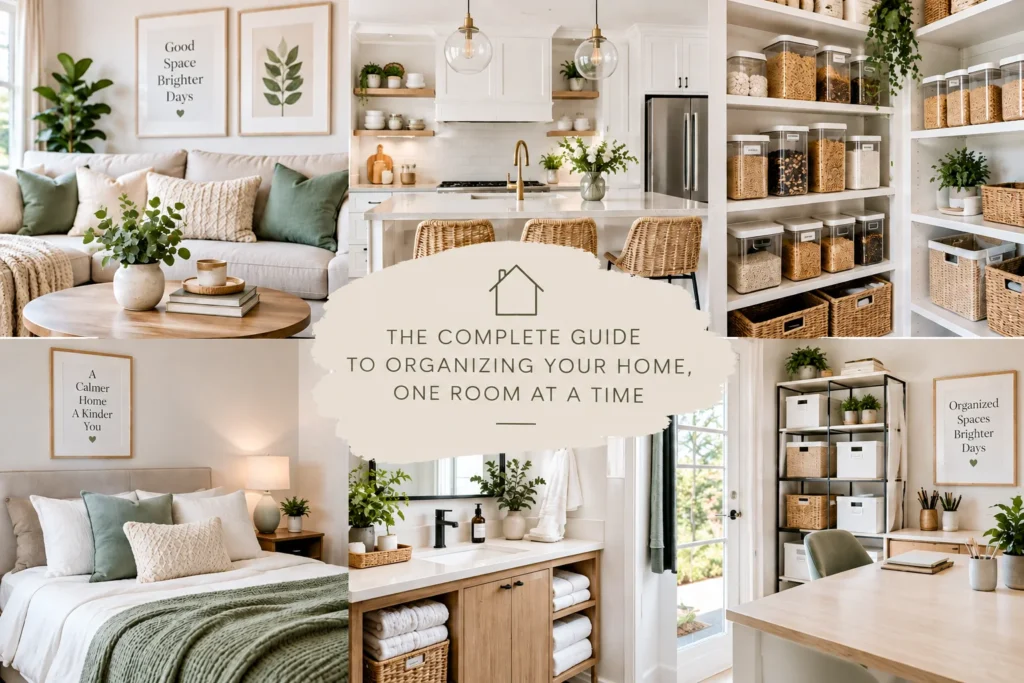
Organizing an entire home can sound like a project that requires empty weekends, matching containers, and a naturally tidy personality. It does not. A home becomes easier to manage when every room has a clear purpose, frequently used items have sensible homes, and the amount you keep fits the space you actually have.
This guide gives you a room-by-room system you can use gradually. You will learn where to begin, how to decide what stays, how to create practical zones, what to organize before buying storage, and how to maintain the result without constantly starting over.
Quick Answer
The simplest way to organize your home is to work one small area at a time: remove obvious clutter, group similar items, decide what belongs in the space, assign each category an easy-to-reach home, and then add containers only where they solve a real storage problem. Finish each area before moving to the next. A functional system is more valuable than a picture-perfect one.
Before You Organize: Define What “Organized” Means
An organized home is not necessarily minimalist. It is a home in which you can find what you need, put things away without unnecessary effort, and use rooms for their intended purposes.
Before touching a drawer, identify your biggest friction points. Maybe the entryway collects bags and shoes. Perhaps kitchen counters disappear under paperwork, or clean laundry stays in baskets because closets are too full. Those recurring problems are useful information. They show where your systems are failing.
Write down three to five problems that make daily life harder. Prioritize those before decorative organizing projects. Fixing a chaotic medicine cabinet may be satisfying, but creating a landing zone for keys can save time every day.
The Five-Step Home Organization Method
1. Choose a Small, Defined Area
Do not begin with “the kitchen.” Begin with one pantry shelf, one cabinet, or one countertop. A clearly defined area gives you a finish line and prevents the familiar situation in which everything is pulled out and the room looks worse at bedtime.
2. Remove What Does Not Belong
Take out rubbish, expired items, obvious donations, and objects that belong elsewhere. Avoid walking around the house returning every stray object immediately; that can turn one task into ten. Use a temporary “belongs elsewhere” basket and redistribute it when the area is finished.
3. Group Like With Like
Put similar items together before deciding where they should live. Seeing all batteries, reusable bottles, baking supplies, toiletries, or craft materials together makes duplicates visible and helps you estimate the storage space each category truly needs.
4. Give Every Category a Home
The best storage location usually follows frequency of use. Everyday items deserve the easiest access. Occasional items can go higher, lower, or farther back. Heavy objects are generally safer on lower shelves. Items used together should live near one another when practical.
5. Add Storage Only After Editing
Containers do not create organization by themselves. They organize what you have already decided to keep. Measure shelves and drawers before purchasing bins, dividers, turntables, or baskets. Choose a container because it solves a specific problem, not because it looks attractive online.
Room 1: Entryway
The entryway has to absorb objects that arrive with people: shoes, keys, bags, mail, jackets, umbrellas, and sometimes sports gear. Without a landing system, those items migrate to tables and counters.
Start by deciding what genuinely needs to stay near the door. Give keys a hook, tray, or small bowl. Limit shoe storage to pairs worn regularly and move seasonal or special-occasion footwear elsewhere. Hooks can be easier than hangers for everyday bags and jackets, particularly for children.
Create one controlled place for incoming paper. A slim tray or wall pocket is enough if it is processed regularly. The goal is not to store mail indefinitely; it is to prevent it from spreading.
If the entry is tiny, use vertical space. Wall hooks, a narrow shoe cabinet, an over-door solution, or a bench with hidden storage can add function without consuming much floor area.
Room 2: Living Room
Living rooms often serve several roles: relaxing, entertaining, playing, reading, and sometimes working. Organization improves when each activity has a modest zone.
Begin with surfaces. Remove objects that do not support how the room is used. Corral remote controls in one predictable place. Give blankets a basket or shelf. Keep children’s toys in a limited number of accessible containers rather than scattering storage throughout the room.
Closed storage is useful for visually busy categories such as games, cables, craft supplies, and electronics accessories. Open storage works better for items you want to see and use, such as books or a few decorative objects.
Be cautious with “miscellaneous” baskets. They are convenient temporarily but become clutter containers when no one knows what belongs in them.
Room 3: Kitchen
Kitchen organization should support movement: storing food, preparing it, cooking, serving, and cleaning.
Think in work zones. Keep everyday cooking tools close to the preparation or cooking area. Store plates and glasses where they can be put away easily. Group baking ingredients and equipment together if you bake regularly. Keep food-storage containers near the area where leftovers are packed.
Empty one cabinet at a time. Remove damaged utensils, duplicate gadgets you never use, and containers without matching lids. Place frequently used cookware where you can reach it without moving several other items.
Drawer dividers can prevent utensils from drifting into piles, but do not divide a drawer into more categories than you can maintain. Simple systems usually survive busy weeks better.
Room 4: Pantry and Food Storage
Group food into categories that match how your household cooks: breakfast, snacks, baking, grains, canned goods, sauces, or meal components. There is no universal pantry taxonomy.
Place frequently used food at eye level or within easy reach. Keep children’s approved snacks accessible if appropriate for your household. Store backstock separately from open items so you can see what needs replacing.
Clear containers can help with dry goods when decanting genuinely makes quantities easier to see, but transferring every grocery item is not required. Original packaging often provides useful cooking, allergen, expiration, and nutrition information.
Use a first-in, first-out habit: older products move forward, newer ones go behind. Check dates periodically and avoid buying duplicates simply because an item is hidden.
Room 5: Bedroom
A bedroom should make sleeping, dressing, and getting ready easier. Start with the surfaces nearest the bed and then address clothing.
Remove items that belong in other rooms. Keep the nightstand limited to what you actually use there. For clothing, separate what fits your current life from items kept out of guilt, fantasy, or habit.
Organize closets by category first – tops with tops, trousers with trousers, and so on – then use subcategories only if they help. Store the most frequently worn clothes in the easiest locations. Seasonal items can move to less accessible shelves or labeled containers.
If clothing repeatedly lands on a chair, study the behavior rather than blaming yourself. You may need a hook for tomorrow’s outfit, a hamper closer to where you undress, or a designated place for clothes that are worn but not ready to wash.
Room 6: Bathroom
Bathrooms contain many small items and are often short on storage. Start by safely disposing of empty packaging and products you no longer use, following local guidance for medications and hazardous products.
Group daily toiletries together and keep occasional products elsewhere. Drawer organizers are helpful for small categories, while shallow bins can stop products from disappearing at the back of cabinets.
Do not overfill storage under sinks, especially around plumbing. Leave access for inspection and repairs, and protect products from leaks. Store medicines according to their label instructions rather than automatically placing them in a humid bathroom.
Room 7: Laundry Area
A good laundry system reduces the number of decisions between dirty clothes and clothes returned to their homes.
Keep detergent and routine supplies together, safely stored according to manufacturer guidance and away from children and pets. Use hampers where clothes naturally accumulate. If sorting before washing helps your household, separate hampers can reduce an extra step.
Create a small place for stain-treatment supplies, lost socks, and items that need repair. The key is to prevent these categories from becoming permanent holding zones.
Room 8: Home Office or Paperwork Zone
Paper clutter becomes difficult because some documents require action while others require storage.
Separate papers into action, reference, and discard/shred categories. Keep current action items visible enough that you remember them, but not spread across every surface. File only documents you actually need to retain.
Digital organization matters too. Scan documents only when a digital copy is appropriate, use clear file names, and maintain backups for important records. Sensitive documents should be stored securely.
For office supplies, keep everyday items within reach and backstock farther away. You probably do not need twelve pens on the desktop just because you own twelve pens.
Room 9: Children’s Spaces
The easiest children’s systems are visible, simple, and reachable. Broad categories such as blocks, vehicles, art supplies, and stuffed toys are often easier to maintain than highly specific sorting.
Use labels with words, pictures, or both depending on the child’s age. Limit the number of toys available at once if an overloaded room makes play and cleanup harder. Rotating toys can create breathing room without requiring you to discard everything.
Secure furniture and storage units appropriately and avoid placing heavy items where children could pull them down.
Room 10: Utility, Garage, or General Storage
Storage rooms become dumping grounds when they contain objects without defined categories. Divide the area by function: tools, household maintenance, seasonal décor, outdoor equipment, bulk supplies, and so forth.
Label closed containers clearly. Keep hazardous products in appropriate original containers and store them according to their instructions. Do not place heavy boxes high overhead if they will be difficult to retrieve safely.
Before creating elaborate shelving, remove what you no longer need. Increasing storage capacity without reducing unnecessary possessions can simply create a larger clutter system.
How to Choose Organizers Without Wasting Money
Measure first: width, depth, height, shelf clearance, and drawer dimensions. Consider whether a bin needs handles, whether a lid will become annoying, and whether you need to see the contents.
Open baskets are useful for frequently accessed categories. Lidded containers can protect seasonal or rarely used items. Drawer dividers keep small objects separated. Turntables can improve access in certain deep cabinets. Shelf risers make vertical space usable.
Matching containers are optional. Consistency can make a room look calmer, but functionality should come first.
Common Home Organization Mistakes
One common mistake is organizing too much at once. Another is buying containers before deciding what will be stored. People also create categories that are too precise, hide frequently used objects in inconvenient places, or design systems that only work when everyone has plenty of time.
A useful test is simple: can the item be put away in roughly the same amount of effort it takes to leave it out? If putting it away requires opening three boxes and rearranging a shelf, the system may be too complicated.
How to Maintain an Organized Home
Maintenance works best as a collection of small resets. Return items to their homes when leaving a room when practical. Clear high-traffic surfaces regularly. Review one problem area during a weekly reset.
Use a one-in, one-out guideline selectively for categories that tend to grow, such as mugs, clothes, toys, or beauty products. It does not have to be a rigid household law.
Most importantly, adjust systems that repeatedly fail. Organization should adapt to real behavior. If everyone drops shoes beside the door, placing shoe storage there is often more effective than trying to train the entire household to use a closet across the house.
EverEight Pro Tip
Before buying an organizer, place a temporary cardboard box or spare basket where you think the new system should go and use it for a week. If everyone naturally uses that location, you have evidence that the permanent organizer will solve a real problem.