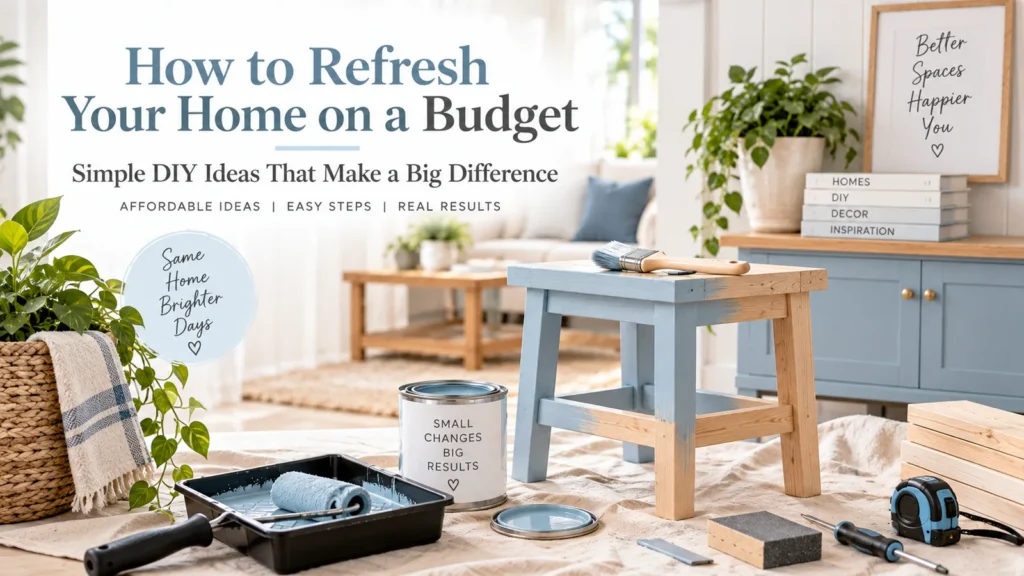
A noticeable home update does not always require new furniture or renovation.
Small changes can have visual impact when they affect a large sightline, repeat across a room, reduce visible clutter, or create a stronger focal point. The key is spending on the part people actually see rather than rebuilding something that already functions.
These 20 budget DIY projects focus on cosmetic and organizational changes. Costs vary by location and materials, so treat “budget” as a strategy rather than a fixed dollar amount.
1. Repaint a Small Piece of Furniture
A side table, stool, or small cabinet can become a focal point with a compatible finish.
Use what you already own when possible.
Prepare the surface according to the paint or finish instructions, and consider whether older coatings may require special handling before sanding.
Budget strategy: Change the finish instead of replacing the furniture.
2. Update Existing Picture Frames
Paint suitable frames, replace mats, or create a more consistent arrangement.
Do not alter valuable or collectible frames without researching them.
Budget strategy: Reuse the glass, backing, and frame structure.
3. Create a Gallery Wall From Existing Art
Gather photographs, prints, children’s art, postcards, or other suitable pieces.
Lay the arrangement out before hanging.
Use wall fasteners appropriate for the wall and load.
Budget strategy: The visual impact comes from grouping, not expensive art.
4. Paint the Back of a Bookcase
A contrasting or coordinated back panel can change how the entire bookcase reads.
Use a compatible finish and protect shelves and surroundings.
If the bookcase is valuable, veneered, or has a delicate finish, test first.
Budget strategy: Paint a small surface that visually frames many objects.
5. Replace Furniture Knobs or Pulls
Hardware can update a dresser or cabinet quickly.
Use the existing hole spacing to avoid drilling new holes.
Measure center-to-center dimensions before buying pulls.
Budget strategy: Replace the smallest visible component.
6. Add a Removable Liner to Shelves or Drawers
A suitable removable liner can add pattern or make a storage area feel finished.
Check whether the adhesive is appropriate for the surface and removable as claimed under your conditions.
Budget strategy: Use small quantities in high-visibility areas.
7. Create Coordinated Storage Labels
Labels can make open storage feel more deliberate.
Use broad categories and a consistent format.
Do not label for appearance alone if the label makes the system harder to maintain.
Budget strategy: Improve visual order without buying new containers.
8. Refresh a Lampshade Safely
Replace an old shade with a compatible new one or decorate only using methods and materials specifically suitable for lampshades.
Do not interfere with ventilation, bulb clearance, or electrical components.
Budget strategy: Update the visible part of an existing lamp rather than replacing the whole fixture.
9. Make a Fabric Table Runner
A simple hemmed or suitable no-sew runner can introduce color and texture.
Choose washable fabric if the table is used for meals.
Keep fabric away from open flames and hot serving items.
Budget strategy: One narrow piece of fabric changes a large surface.
10. Create a Decorative Tray Group
Use an existing tray to contain a few everyday items on a coffee table, dresser, or entryway.
Refresh the tray if needed with a suitable finish.
Budget strategy: Reorganize what is already visible.
11. Paint Interior Plant Pots
Use a compatible product on suitable pots and preserve drainage.
For indoor plants, protect furniture and floors from moisture.
Budget strategy: Repeat one color across several small objects.
12. Make a Simple Wall Banner
Use fabric, paper, or another lightweight material to create wall art.
Mount it safely and keep cords out of reach where they could create entanglement risk.
Budget strategy: Fill vertical space with inexpensive lightweight material.
13. Create a Framed Textile Panel
Frame fabric you already own or a small remnant.
This can produce a large pattern for less than a comparable art print.
Budget strategy: Buy by the small cut rather than by the finished artwork.
14. Refresh Open Shelves by Editing, Not Buying
Remove everything, clean the shelves, and return fewer objects in intentional groups.
Use books, plants, baskets, and items you already own.
Budget strategy: Subtraction costs nothing.
15. Create a Simple Entryway Drop Zone
Use a small tray, existing bowl, hooks, or a compact board to give keys and daily items a home.
If installing hooks, use appropriate fasteners and load limits.
Budget strategy: Improve a high-traffic sightline and reduce clutter at the same time.
16. Add Removable Pattern to a Small Niche
A small alcove, cabinet back, or other suitable surface can carry wallpaper or removable material without the cost of covering a whole room.
Measure carefully and check surface compatibility.
Budget strategy: Concentrate pattern in a small architectural area.
17. Refinish a Mirror Frame
A compatible finish can update a dated mirror frame.
Protect the mirror surface and avoid changing the mounting hardware unless you understand its load requirements.
Budget strategy: Keep the mirror; change only the frame appearance.
18. Make a Simple Decorative Hook Rail
Use a premade board and a few hooks.
Paint or finish the board, measure hook spacing, and mount appropriately.
Use it for lightweight accessories within the hardware’s capacity.
Budget strategy: Combine decoration and storage.
19. Refresh Soft Furnishings With Covers
Cushion covers can change a room more cheaply than replacing entire cushions.
Sew simple covers or use well-constructed premade covers.
Check size before purchasing fabric or covers.
Budget strategy: Reuse inserts and change only the visible textile.
20. Paint a Defined Accent Shape or Panel
Instead of painting an entire room, use a carefully planned block, arch-style shape, or rectangular panel where appropriate.
Use painter’s tape and a level or straightedge for crisp geometry.
A painted feature should not cover safety labels, electrical components, or building defects.
Budget strategy: Use a small amount of paint to create a large visual focal point.
What Creates the Biggest Visual Difference?
Three things tend to matter.
Scale
A change visible from the doorway has more impact than a tiny detail hidden in a drawer.
Repetition
Changing several matching knobs or repeating one frame color creates cohesion.
Clutter reduction
Removing visual noise can change a room more than adding décor.
Before spending, take a photo from the main entrance to the room and identify the largest visible surfaces.
How to Set a DIY Budget
Choose a maximum before shopping.
Separate:
- Materials that become part of the project.
- Consumables.
- Tools.
- Delivery.
- Contingency.
If the tool cost is larger than the project, consider borrowing or renting where appropriate.
Keep receipts until the project is complete.
Use What You Already Own First
Before buying:
- Check leftover paint.
- Review frames.
- Look for fabric remnants.
- Inspect unused baskets or trays.
- Check spare hardware.
- Consider whether furniture can be moved rather than replaced.
Do not reuse old chemicals, finishes, or materials that are degraded, unlabeled, unsafe, or unsuitable for the new task.
When Cheap Becomes Expensive
A low-cost product can become expensive if it fails quickly or damages the underlying surface.
Be cautious with:
- Adhesives on delicate finishes.
- Poorly rated wall hardware.
- Paint incompatible with the substrate.
- Weak furniture hardware.
- Materials that cannot tolerate moisture or heat where they are placed.
Spend on safety and compatibility first. Save on decorative extras.
How to Avoid the “DIY Supply Trap”
A $15 project can turn into a $100 shopping trip if you buy every optional accessory.
Write a strict materials list.
If a tutorial uses a specialty tool for convenience, ask whether a basic tool can safely achieve the same result.
Do not improvise a dangerous substitute. Saving money is not a reason to use the wrong tool.
Budget Project Safety
Cosmetic projects still involve risk.
Ventilate finishes as directed. Use appropriate PPE. Keep tools and small parts away from children and pets. Mount objects safely. Avoid drilling where hidden utilities may be present.
Do not cover moisture damage, cracks, electrical problems, or structural issues with decorative materials. Investigate the underlying problem.
EverEight Pro Tip
Spend your first budget dollar on the room’s biggest repeated visual element – several frames, several knobs, one large clear surface, or one strong focal area. Repetition makes a small budget look intentional.