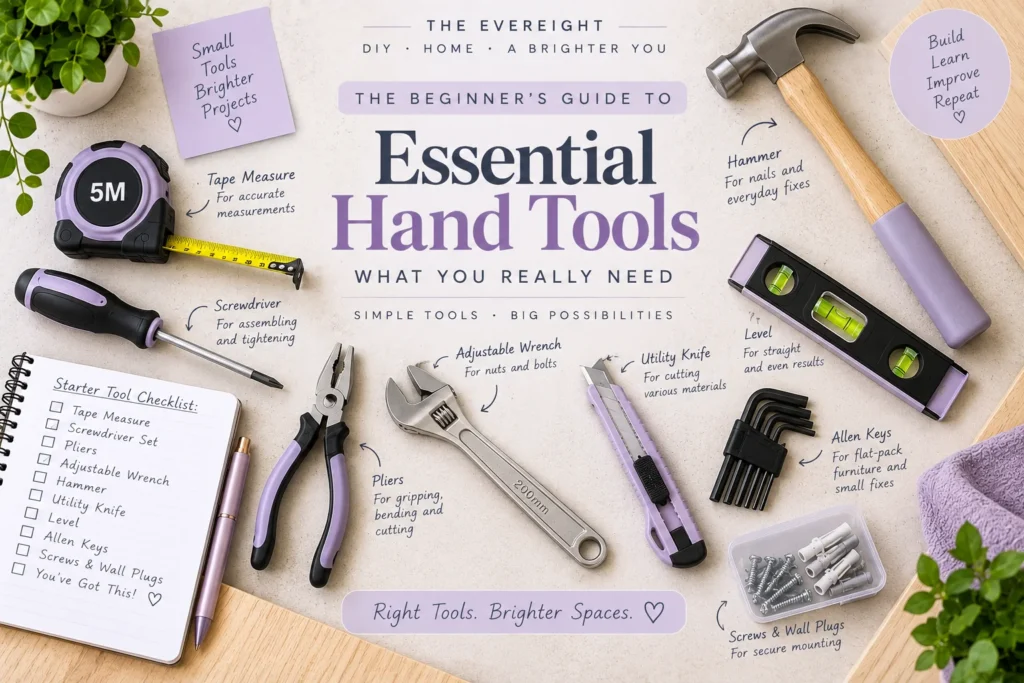
Power tools get attention, but hand tools solve many of the jobs that happen most often around a home.
They tighten a loose handle, measure a space, grip a fitting, remove a nail, mark a cut, hold a workpiece, or make a small adjustment without batteries, chargers, noise, or a large setup.
The important skill is not owning all 20 tools. It is understanding what each is designed to do – and when a different tool or professional is the safer choice.
Quick Answer
The most broadly useful homeowner hand tools include a tape measure, hammer, screwdrivers, pliers, adjustable wrench, utility knife, level, square, clamps, hex keys, socket/ratchet tools, putty knife, pry bar, hand saw, and several task-specific gripping or marking tools. Buy gradually and keep tools in safe condition.
1. Tape Measure
Use it for room dimensions, furniture, shelves, lumber, hardware spacing, and clearances.
Read from the correct reference point and write dimensions down.
For repeated project parts, use consistent measuring methods to avoid cumulative errors.
2. Claw Hammer
The striking face drives appropriate nails; the claw can remove them.
Choose a hammer you can control.
Do not strike hardened metal tools with a general claw hammer unless the tools are designed for that use.
Inspect the head and handle before use.
3. Phillips Screwdriver
Phillips-style screws are common in household hardware.
Use a driver that fits the recess closely.
If the tip cams out repeatedly, stop and check the size, screw condition, and required driver type.
4. Slotted Screwdriver
Slotted screws remain common on some hardware and fixtures.
Do not use a screwdriver as a chisel, pry bar, punch, or electrical test tool.
The shaft and handle were designed for turning screws.
5. Multi-Bit Screwdriver
A quality multi-bit driver reduces the number of handles you store.
Check that the bit locks securely.
Keep the included bit types organized.
It is useful for household variety but may be bulkier than a dedicated driver in tight spaces.
6. Combination Pliers
Combination pliers can grip and manipulate suitable materials and may include cutting edges.
Use the gripping area appropriate to the task.
Do not use ordinary pliers on energized electrical conductors.
7. Needle-Nose Pliers
The narrow jaws reach small spaces and handle small parts.
They are useful for craft, hardware, and mechanical tasks.
Do not apply excessive leverage to delicate tips.
8. Tongue-and-Groove Pliers
Adjustable jaws can grip larger fittings and irregular shapes.
They are common in some plumbing-related tasks, but gripping a fitting incorrectly can damage finishes or components.
Major plumbing work or uncertain shutoff conditions may require professional help.
9. Adjustable Wrench
An adjustable wrench fits a range of nut and bolt sizes.
Adjust the jaws snugly.
Apply force in the orientation recommended for the wrench design and keep the tool square to the fastener.
A fixed wrench is often better for repeated work.
10. Socket and Ratchet
Sockets surround a nut or bolt and can provide efficient turning in limited arcs.
Use the correct size and drive system.
Do not extend a ratchet handle with a pipe unless the tool is specifically designed for that loading.
For high-torque work, use tools intended for it.
11. Hex-Key Set
Hex keys are common in furniture, bicycles, fixtures, and equipment.
Use the exact size.
A slightly undersized key can round the socket.
Both metric and imperial sizes exist.
12. Utility Knife
Use a utility knife for materials it is designed to cut.
Retract or cover the blade when not in use.
Cut away from your body and keep the other hand out of the cut path.
Use a stable cutting surface.
Dispose of used blades safely.
13. Level
A level helps check horizontal and vertical alignment.
It is useful for frames, shelves, appliances where appropriate, and furniture projects.
A level tells you orientation; it does not tell you whether a wall fastening is structurally safe.
14. Combination Square
This tool marks and checks 90-degree relationships and can transfer measurements.
It is especially useful for woodworking and repeated layouts.
Keep the reference surfaces clean; debris can affect accuracy.
15. Clamps
Clamps hold parts while drilling, gluing, assembling, or measuring.
They improve both accuracy and hand position.
Use a clamp that fits the work and does not obstruct the tool path.
Never position a clamp where a saw or drill can contact it unexpectedly.
16. Putty Knife
A flexible putty knife can apply appropriate fillers and assist with some surface-preparation tasks.
Choose a width and stiffness suited to the material.
Clean it after use so hardened residue does not scratch the next surface.
Do not scrape unknown old coatings without considering hazardous-material risks.
17. Small Pry Bar
A pry bar can remove trim, nails, or materials when the task is appropriate.
Protect surfaces with a suitable block where needed.
Prying can reveal hidden nails, wiring, plumbing, damage, or hazardous materials. Demolition should not be treated as harmless simply because the tool is manual.
18. Hand Saw
A hand saw can make many basic wood cuts without a powered saw.
Select the saw type for the material and cut.
Secure the workpiece.
Keep the free hand away from the cut line.
Start with controlled strokes rather than forcing the teeth.
19. Awl or Appropriate Marking Point
An awl can mark locations or create a small starting point in suitable materials.
It is sharp.
Use a stable workpiece and keep your supporting hand away from the point.
Do not substitute it for a drill bit when a drilled hole is required.
20. Flashlight or Headlamp
A light is a tool when visibility affects accuracy and safety.
Use it to inspect behind furniture, inside cabinets, under sinks, or around work areas.
Lighting does not make an electrical or plumbing hazard safe to approach.
Choose a light appropriate to the environment and keep both the light and batteries in good condition.
Tools That Are Useful but Not Universal
Staple gun
Useful for upholstery and some fastening tasks, but fasteners can injure and may penetrate hidden materials.
Chisels
Excellent woodworking tools but require sharpening, control, and suitable striking tools.
Files and rasps
Useful for shaping and deburring suitable materials.
Handsaw specialty types
A hacksaw, coping saw, or flush-cut saw may be valuable for particular materials.
Caulk gun
Useful when applying compatible cartridge products, but surface preparation and product choice determine the quality of the seal.
Buy these when the project calls for them.
Hand Tools Are Not Automatically Safe
A tool without a motor can still cause serious injury.
Common hazards include:
- Slipping blades.
- Flying fragments.
- Pinched fingers.
- Sharp edges.
- Damaged handles.
- Incorrect striking tools.
- Excessive leverage.
- Workpieces that move unexpectedly.
Established safety guidance emphasizes maintaining hand tools in safe condition and removing damaged tools from service.
How to Choose Hand Tools
Fit
The tool should fit the fastener and your hand.
Condition
Jaws, tips, striking faces, blades, and handles should be sound.
Material
The tool should be designed for the load and task.
Replaceability
Standard blades, bits, and accessories make long-term ownership easier.
Storage
A tool you cannot find may as well not exist.
Cheap vs Expensive Hand Tools
Price alone does not determine suitability.
For occasional light use, a modest tool may perform well.
Spend more when precision, comfort, repeated use, or high loads justify it.
Avoid tools with visibly poor fit, loose heads, damaged insulation claims, weak locking mechanisms, or unclear specifications.
Tool Maintenance Basics
Keep tools clean and dry.
Protect metal from corrosion according to manufacturer guidance.
Replace worn blades.
Keep cutting tools appropriately sharp; dull tools can require excessive force.
Do not modify handles or grind tools unless that maintenance is intended for the tool and you know the correct procedure.
Inspect before use.
Organizing Hand Tools
Store by function:
- Measuring and marking.
- Drivers and bits.
- Gripping and wrenches.
- Cutting.
- Striking.
- Clamps.
- Specialty tools.
This makes it easier to see what you already own before buying duplicates.
Which Five Should You Buy First?
For a very small starter set: 1. Tape measure. 2. Multi-bit screwdriver or useful screwdriver pair. 3. Hammer. 4. Pliers. 5. Adjustable wrench.
Then add a level, square, utility knife, and clamps according to projects.
Your first five may differ if you do woodworking, bicycle maintenance, or another specific activity.
Hand Tools vs Power Tools
Use hand tools when they provide enough speed and control.
Power tools become useful when repetition, hole-making, cutting, or material demands justify them.
A manual screwdriver can be safer for delicate furniture hardware than a powerful driver.
The best tool is the one suited to the task.
What Homeowners Should Not Attempt Just Because They Own Tools
Tool ownership does not establish competence for:
- Energized electrical work.
- Gas systems.
- Structural modification.
- Roofing at height.
- Major plumbing.
- Hazardous-material disturbance.
- Fire-safety systems.
- Work requiring licensed professionals or permits.
Know the boundary between maintenance and specialist work.
EverEight Pro Tip
Put a small piece of removable tape on every new hand tool and write the month you bought it. After a year, look at which tape is still pristine. That shows which tool categories you actually use before you upgrade or expand them.
Optional Tool Recommendation
Affiliate disclosure: As an Amazon Associate, The EverEight earns from qualifying purchases.
Amartisan 10-Piece Magnetic Screwdriver Set: A set of manual screwdrivers for suitable household fastening tasks. Check tip types and sizes before buying. View on Amazon.