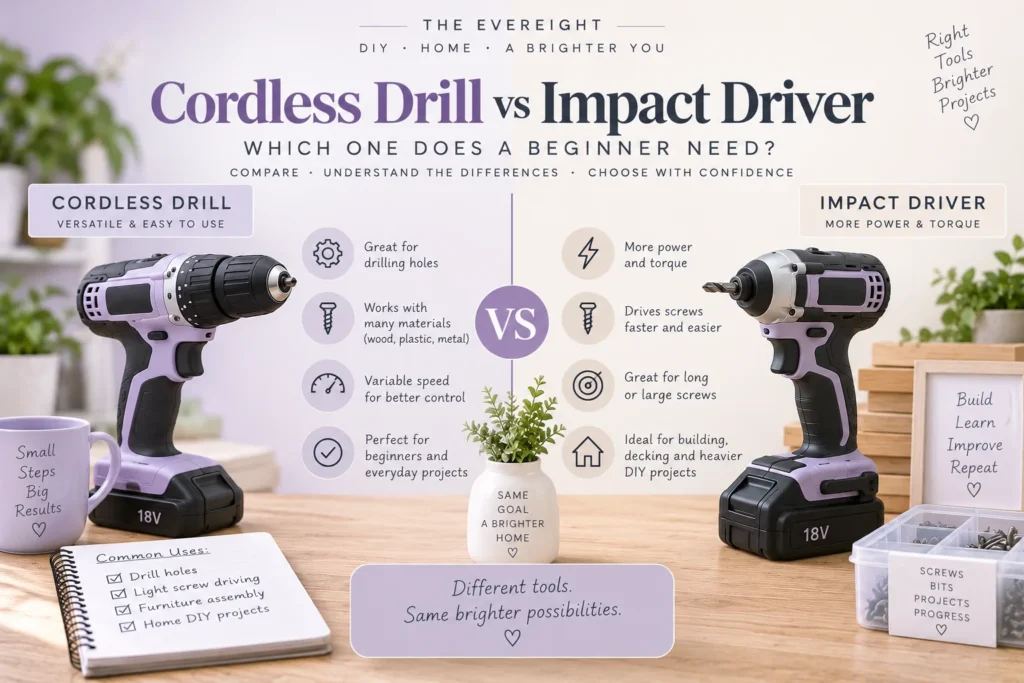
A cordless drill and an impact driver can both turn fasteners, which makes them look interchangeable. They are not.
A drill/driver is designed to drill holes and drive screws with adjustable speed and, on many models, an adjustable clutch. An impact driver is optimized for driving fasteners using rapid rotational impacts when resistance increases.
For a beginner buying one tool, the drill/driver is usually the more versatile starting point. The impact driver becomes valuable when your projects involve repeated or demanding fastening.
Quick Verdict
Buy a cordless drill/driver first if you need one general-purpose tool for household DIY.
Add an impact driver when you frequently drive long screws or other demanding fasteners, build larger projects, or want to keep a drill bit in one tool and a driver bit in the other.
An impact driver is not a replacement for every drilling task, and more driving force is not automatically safer or better.
What a Drill/Driver Does
A drill/driver uses a chuck that can accept a wide range of compatible round- or hex-shank accessories within its capacity.
Typical uses include:
- Drilling holes in wood and other suitable materials with the correct bit.
- Driving screws.
- Making pilot holes.
- Using hole-making accessories within the tool’s rated capability.
- Light furniture and cabinet work.
The adjustable clutch on many drills provides useful screw-driving control.
What an Impact Driver Does
An impact driver typically uses a quick-release hex collet.
When resistance increases, the mechanism delivers rotational impacts that help drive fasteners.
Typical uses include:
- Repeated screw driving.
- Longer structural-type screws when the fastener, material, and tool are appropriate.
- Bolts or nuts with compatible impact-rated accessories where the tool manufacturer permits.
- Construction-style fastening.
Impact drivers can feel compact for their capability, but they are often louder and transmit a different sensation to the user.
The Biggest Difference: How They Deliver Rotation
A drill provides continuous rotation through its motor and gearbox.
An impact driver adds rotational impacts under load.
That impact action can make demanding fasteners easier to drive, but it can also overdrive or damage small fasteners if the user applies too much trigger.
Technique still matters.
Drill vs Impact Driver for Drilling Holes
The drill wins for general drilling.
Its chuck accepts a broader variety of standard drill bits.
Impact drivers can use impact-rated hex-shank drill bits, but that does not make them ideal for every hole.
For precision, delicate materials, or a broad drill-bit selection, the drill is usually the better choice.
Drill vs Impact Driver for Screws
For small to medium screws, furniture, hinges, hardware, and tasks where controlled depth matters, a drill/driver’s clutch is valuable.
For repeated long screws or demanding fastening, an impact driver may work faster and reduce sustained reaction torque felt at the handle.
However, the impact action can damage screw heads or materials if used carelessly.
Use appropriate bits and fasteners.
Control
Beginners often benefit from the drill’s adjustable clutch.
Start with a lower setting and increase as needed for the screw and material.
Impact drivers generally rely more on trigger control and technique.
Some current models have multiple electronic modes, but features vary by manufacturer and model.
Noise
Impact drivers are typically much louder during impact operation than drill/drivers.
Hearing protection may be appropriate depending on the sound exposure and task.
Do not underestimate noise simply because the tool is small.
Accessory Compatibility
Drill
Commonly uses a three-jaw chuck and accepts many drill bits and driver accessories within its capacity.
Impact driver
Commonly uses 1/4-inch hex-shank accessories.
Use impact-rated driver bits and sockets where required.
Do not put a non-impact-rated socket on an impact tool merely because an adapter makes it physically fit.
Size and Weight
Impact drivers are often shorter from front to back, which can help in tight spaces.
A compact drill can also be very small.
Battery size can change the balance of either tool.
Compare the complete tool with battery rather than generalizing from the tool category.
What About Torque?
Impact drivers are designed for strong fastening performance, but manufacturer torque figures can be difficult to compare directly across brands and test methods.
A higher number does not mean better control.
For household screws, excess capability may provide no benefit.
What About a Hammer Drill?
A hammer drill is a drill with an additional hammering action for suitable masonry drilling.
It is not an impact driver.
The words “hammer” and “impact” describe different mechanisms.
If masonry is your main concern, evaluate a hammer drill or appropriate rotary-hammer solution based on the material and project.
Which Tool for Furniture Assembly?
Usually the drill/driver, or even a manual screwdriver.
Flat-pack furniture often uses relatively small fasteners and materials that can be damaged by overdriving.
Use low clutch settings where appropriate and finish delicate fasteners manually if needed.
Do not use an impact driver at full power simply because it is faster.
Which Tool for Hanging Shelves?
The drill/driver is usually more useful because you may need to drill pilot or anchor holes and then drive fasteners.
The correct wall assessment, fastener, and load design matter more than the tool.
For structural fastening, follow the shelf system and fastener instructions.
Which Tool for Deck or Framing-Style Projects?
An impact driver can be very useful for repeated fastening.
But these projects involve more than owning the tool. Fastener specifications, structure, codes, saw work, work support, and project design matter.
A beginner should use a proven plan and appropriate guidance.
Which Tool for Woodworking?
A drill/driver is the first choice.
It handles pilot holes, countersinking with appropriate accessories, and controlled screw driving.
An impact driver can become a second tool for assembly or larger fasteners.
Many woodworkers use both because each can remain set up for a different task.
Do You Need Both?
Not initially.
Buy both when the workflow justifies it.
Two tools are convenient when you repeatedly switch between drilling and driving: keep a drill bit in the drill and a driver bit in the impact driver.
A combo kit can be good value if both tools are suitable models and you will use them.
One Battery Platform or Separate Brands?
Using one compatible battery platform can reduce chargers and spare batteries.
But choose the tools you actually like.
If you already own batteries, that ecosystem deserves consideration, not automatic loyalty.
Verify current battery compatibility within the manufacturer’s platform.
Safety Differences
Both tools can injure the user if mishandled.
Secure the workpiece.
Use the correct accessory.
Inspect the tool, battery, chuck or collet, and bit.
Keep hands clear.
Wear appropriate eye protection and other PPE for the task.
An impact driver’s rotational impacts do not eliminate reaction forces or other hazards.
Follow the manufacturer instructions.
Beginner Buying Scenarios
You assemble furniture and do small home projects
Choose a drill/driver.
You build shelves, boxes, and simple woodworking projects
Start with a drill/driver. Add an impact driver if repeated fastening becomes a real need.
You are building a deck or similar larger project
An impact driver may be valuable, but project design and structural requirements matter. A drill will still be useful.
You mainly drill holes
Choose a drill appropriate to the material. An impact driver is not the primary tool.
You already own a drill and frequently struggle with long fasteners
An impact driver may be a sensible second purchase.
Drill/Driver vs Impact Driver Comparison
General drilling: Drill/driver.
Controlled screw driving: Drill/driver.
Long repeated fasteners: Often impact driver.
Accessory variety: Drill/driver.
Compact head length: Often impact driver, model-dependent.
Noise: Drill/driver is generally quieter.
First tool for beginners: Usually drill/driver.
Second fastening tool: Often impact driver.
Common Buying Mistakes
Buying an impact driver as the only drilling tool: Accessory options are more limited.
Using ordinary bits that are not intended for impact: Accessories can fail prematurely or dangerously.
Choosing by torque alone: Control and project fit matter.
Buying both because a bundle is discounted: Unused tools are not savings.
Ignoring batteries: A combo kit’s battery sizes affect runtime and weight.
Editorial Note
Our comparisons are based on independent research and practical evaluation criteria. Individual models vary substantially. Specifications, batteries, modes, bundles, warranties, and prices change, so verify current manufacturer information before purchasing.
EverEight Pro Tip
If you are unsure whether you need an impact driver, keep using your drill until you can name the repeated fastening task that frustrates you. The moment the same limitation appears across several projects, you have a real buying reason.
Optional Tool Recommendation
Affiliate disclosure: As an Amazon Associate, The EverEight earns from qualifying purchases.
DEWALT DCK240C2 Drill & Impact Driver Combo: A two-tool option if you expect to need both drilling and frequent screw-driving. A beginner doing occasional light tasks may not need both. View on Amazon.