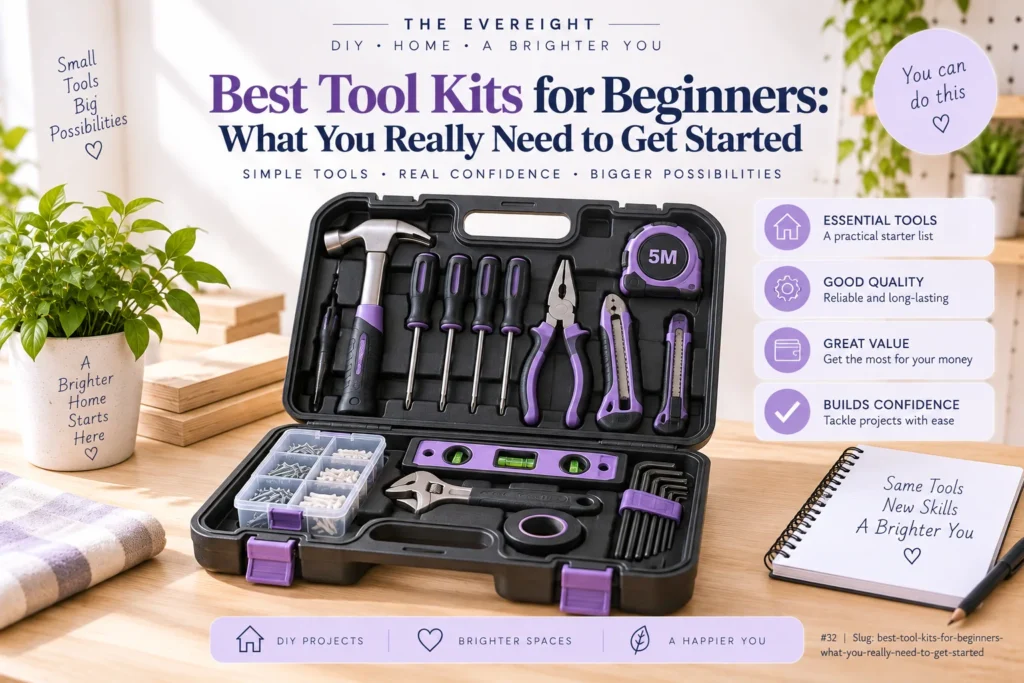
A beginner tool kit is useful only when the tools inside solve jobs you will actually do.
Large piece counts can be misleading. A 150-piece kit may include dozens of bits, sockets, or tiny accessories while omitting a good level, useful clamps, or a drill. A smaller kit with reliable basics can be the better purchase.
This buying guide explains how to compare kits by capability rather than marketing numbers. Specific products change frequently, so use these criteria before selecting a current model.
Quick Verdict
For most beginners, the best starter kit is a compact hand-tool set containing a tape measure, screwdrivers or a quality multi-bit driver, pliers, an adjustable wrench or useful wrench sizes, a hammer, a level, and a safe cutting tool. Add a drill/driver separately or choose a power-tool bundle only if your upcoming projects genuinely require it.
Do not buy the kit with the highest piece count by default.
First Decide: Hand-Tool Kit or Power-Tool Kit?
These are different purchases.
Hand-tool kit
Best for furniture assembly, adjustments, hanging lightweight décor with appropriate hardware, basic household fixes, measuring, gripping, and fastening.
Drill/driver starter kit
Best when you need to drill holes or drive many screws.
Multi-power-tool bundle
Potentially useful for someone with a clear DIY project pipeline, but often unnecessary for a true beginner.
A circular saw, reciprocating saw, impact driver, oscillating tool, and grinder are not “free extras” if you have no safe use for them.
The Core Tools a Beginner Kit Should Cover
Measuring
A tape measure.
Marking and alignment
A pencil or marking tool plus a level or square.
Fastening
Phillips and slotted screwdrivers or a robust multi-bit system.
Gripping
Pliers.
Nuts and bolts
An adjustable wrench or useful wrench/socket sizes.
Light striking
A general-purpose hammer.
Controlled cutting
A safe utility knife for appropriate materials.
These functions matter more than whether the case contains 50 or 200 pieces.
What About a Ratchet and Socket Set?
Sockets are valuable for furniture, bicycles, automotive work, and household hardware that uses hex-head fasteners.
But a large automotive-style socket assortment may be excessive if your projects are mostly décor and woodworking.
Check the fastener sizes you encounter.
A kit should match your work.
What About Hex Keys?
They are common in flat-pack furniture.
A compact metric and/or imperial set can be useful depending on your household products.
Do not assume one measurement system covers everything.
Keep manufacturer-supplied specialty keys when a product requires them.
What About a Level?
Small kits sometimes include a very short level.
It can be useful for compact jobs, but a longer level may be easier for shelves or wider layouts.
Treat tiny levels as convenience tools rather than a reason to choose a kit.
What About Pliers?
At minimum, a general gripping plier is useful.
Needle-nose pliers add reach.
Tongue-and-groove pliers can handle larger appropriate fittings but require correct technique.
Wire cutters do not make electrical work safe; fixed electrical work may require qualified expertise and additional precautions.
What About a Hammer?
Look for a secure head and comfortable grip.
An extremely heavy hammer is not automatically more capable for household DIY.
Control matters.
Inspect any hammer before use and retire damaged tools.
What About a Utility Knife?
A kit may include a retractable knife.
Check whether replacement blades are standard and whether the blade locks securely.
Store blades safely.
A knife is useful for packaging and suitable sheet materials, but it is not a substitute for a saw.
Should the Kit Include a Drill?
There are two reasonable approaches.
Separate purchases: Buy a hand-tool kit and choose a drill independently. This lets you select the drill platform and specifications you want.
Combined starter kit: Convenient if the included drill is a model you would choose on its own.
Do not accept a poorly suited drill simply because the bundle price looks attractive.
If a Drill Is Included, Check These Features
Look at:
- Chuck capacity.
- Variable-speed control.
- Clutch settings for screw driving.
- Forward/reverse.
- Tool weight.
- Battery voltage and capacity.
- Number of batteries.
- Charger.
- Battery-system compatibility.
- Warranty and service information.
For most household DIY, usability matters as much as maximum power.
Battery Ecosystem Matters
Cordless tools often share batteries within a manufacturer’s platform.
That can reduce the cost of future bare tools, but it can also lock you into one ecosystem.
Before buying a large bundle, look at the tools available on that battery platform and the current battery/charger options.
Do not choose a platform based solely on one discounted kit.
How to Read “Piece Count”
Ask what counts as a piece.
Manufacturers may count each driver bit, hex key, socket, drill bit, blade, or small accessory individually.
That is not inherently misleading if clearly described, but the number does not tell you the kit’s capability.
Make a list of the 10 tools you need, then check whether the kit contains those exact functions.
Case Quality Matters More Than It Seems
A fitted case can help you see when a tool is missing.
Check:
- Latches.
- Handle.
- Tool retention.
- Space for consumables.
- Whether tools are easy to remove.
- Whether the case is unnecessarily bulky.
If the case is frustrating, the tools may migrate into random drawers.
Tool Quality: Where Beginners Should Care Most
Prioritize safe construction and reliable fit.
Screwdriver tips should fit fasteners accurately. Pliers should move smoothly. Wrench jaws should not be damaged or sloppy. Tape markings should be readable. Hammer heads should be secure.
For power tools, controls, guards where applicable, battery fit, chuck operation, and manufacturer support matter.
A beginner benefits from predictable tools.
When a Budget Kit Makes Sense
A modest kit can be excellent for:
- A first apartment.
- Occasional furniture assembly.
- Simple household adjustments.
- Emergency household basics.
- Someone who will upgrade individual tools only when needed.
You do not need professional-duty tools for every light household task.
When to Buy Individual Tools Instead
Buy separately when:
- You already own half the kit.
- You have small hands or ergonomic preferences.
- You need one higher-quality specialty tool.
- The kit contains many irrelevant accessories.
- You are building around a specific battery platform.
- Your projects require unusual sizes.
Individual purchasing often creates a smaller, better kit over time.
Tool Kits to Avoid
Be cautious with kits that:
- Emphasize piece count but hide the actual tool list.
- Provide no clear manufacturer specifications.
- Include many duplicate low-value accessories.
- Use proprietary consumables that are hard to replace.
- Have unclear warranty or support.
- Bundle advanced power tools you do not know how to use.
- Encourage electrical or other high-risk work simply by including specialty-looking tools.
Tools do not substitute for training.
A Practical Beginner Kit Checklist
Before buying, look for:
- Tape measure.
- Level or square.
- Screwdriver capability.
- Pliers.
- Wrench capability.
- Hammer.
- Safe cutting tool.
- Useful hex keys.
- A case or storage solution.
Optional:
- Ratchet/sockets.
- Additional pliers.
- Precision screwdrivers.
- Drill/driver.
- Basic bits.
- Clamps, often purchased separately.
Beginner Kit for Apartment Living
Prioritize compact storage and light household tasks.
A hand-tool kit plus a small drill/driver may cover most permitted projects.
Check lease rules before drilling or modifying walls.
Avoid buying large saws or bulky tools unless you have a safe workspace and genuine need.
Beginner Kit for Homeowners
A homeowner may gradually need more measuring tools, clamps, a drill/driver, basic saw capability, and maintenance-specific tools.
Still, build around projects.
Owning a house does not mean you should personally perform electrical, gas, structural, roofing, or other specialist work.
Beginner Kit for DIY Woodworking
General household kits are not complete woodworking kits.
Add clamps, a square, appropriate saw capability, sanding tools, drill/driver, bits, and work support according to the project.
Article #30 offers beginner woodworking project progression.
How Much Should You Spend?
Set the budget after deciding the kit type.
Compare the price of the kit with the individual cost of the tools you actually want.
Ignore the retail value of accessories you would never buy separately.
Consider warranty, replacement parts, battery costs, and storage.
Editorial Note
Our buying guides are based on independent research and practical evaluation criteria. We aim to explain what matters so readers can make informed decisions. Tool bundles, specifications, prices, warranties, and availability can change; verify current information from the manufacturer and retailer before purchasing.
Safety Before Savings
A damaged or unsuitable tool is not a bargain.
Inspect tools before use. Follow manufacturer instructions. Keep guards and safety devices intact. Use appropriate PPE and secure workpieces.
Established tool-safety guidance emphasizes safe tool condition and proper use. A kit should make basic work more practical, not encourage you to attempt work beyond your skill.
EverEight Pro Tip
Score every kit twice: first by the percentage of included tools you expect to use in the next year, then by the percentage of the purchase price represented by those useful tools. The biggest kit rarely wins both tests.
Optional Tool Recommendation
Affiliate disclosure: As an Amazon Associate, The EverEight earns from qualifying purchases.
Amazon Basics 173-Piece General Household Hand Tool Set: A general-purpose kit may be a convenient starting point if you need common household hand tools in one place. Check the included pieces against your actual projects. View on Amazon.