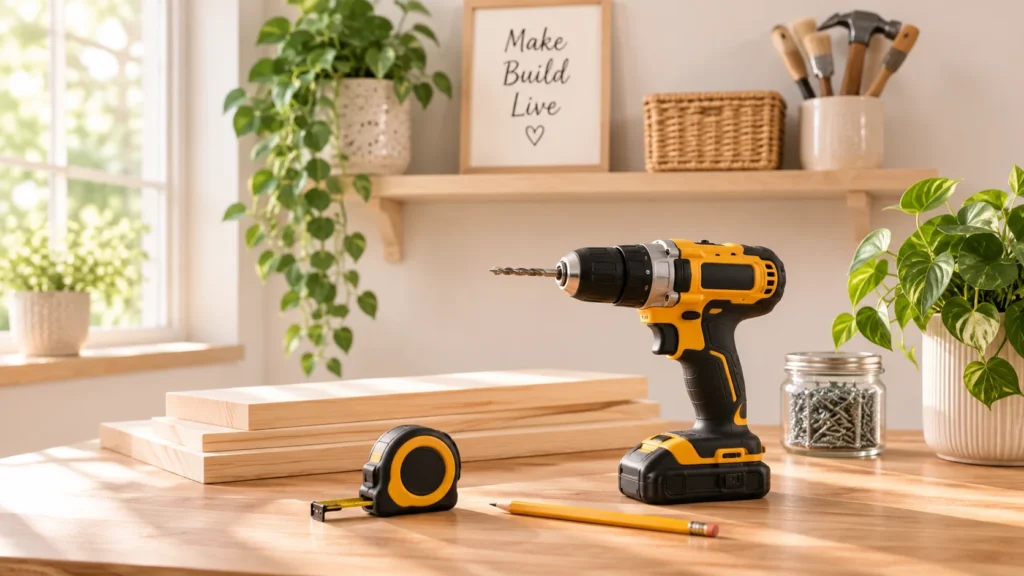
A cordless drill is often the first power tool a beginner buys because it can handle two common jobs: drilling holes and driving screws.
The challenge is that drill listings are full of numbers. Voltage, amp-hours, torque, RPM, chuck size, brushless motors, batteries, and modes can make a simple purchase feel technical.
You do not need the biggest numbers. You need a drill that fits your hand, accepts the accessories your projects require, and provides enough control for the materials you actually work with.
Quick Verdict
For general household DIY, prioritize comfortable weight, variable speed, an adjustable clutch, a useful keyless chuck, forward/reverse, readily available batteries, and a reputable manufacturer with clear specifications. Choose voltage and battery size based on workload rather than assuming more is always better.
If you mostly assemble furniture and hang light items, a compact drill/driver may be ideal. If you expect larger holes, frequent construction work, or masonry drilling, your needs change.
Drill/Driver vs Hammer Drill vs Impact Driver
Drill/driver
Rotates a drill bit or driver bit. An adjustable clutch helps control screw driving.
This is the most versatile first choice for many beginners.
Hammer drill
Adds a hammering action intended for appropriate masonry drilling when used with compatible bits and according to the tool instructions.
It is not the same as an impact driver.
Impact driver
Designed primarily for driving fasteners using rotational impacts. It usually accepts hex-shank accessories rather than standard round-shank drill bits.
Article #34 compares drills and impact drivers in detail.
What Does Voltage Mean?
Voltage describes the electrical potential of the battery system; in practical shopping, it also helps identify the tool platform and general class.
Higher voltage can support more demanding tools, but it usually comes with tradeoffs such as size and weight.
Do not compare drills by voltage alone.
Manufacturers may label nominal and maximum voltage differently, so compare within the actual product specifications rather than assuming two labels are directly equivalent.
What Does Amp-Hour Mean?
Amp-hour, commonly written Ah, relates to battery capacity.
A higher-capacity battery can generally provide longer runtime under comparable conditions, but it also tends to be larger and heavier.
For short household projects, a compact battery may make the drill much more comfortable.
For longer work, a second battery can be more useful than one very heavy battery.
What Is Chuck Size?
The chuck holds drill bits and many driver accessories.
Common drill/drivers use keyless chucks that tighten by hand.
Chuck capacity affects the shank sizes the drill can accept.
Do not buy a drill solely because it has a larger chuck; verify whether your intended bits require it.
Always install accessories according to the manual and confirm they are secured before use.
Why Variable Speed Matters
Variable-speed triggers allow you to start slowly and increase speed with trigger pressure.
Low speed provides control when starting holes or driving screws.
Many drills also have mechanical speed ranges, often a lower-speed/high-torque range and a higher-speed range.
The correct setting depends on the accessory, material, and task.
What Is the Clutch?
The numbered ring behind the chuck on many drill/drivers is an adjustable clutch.
When driving screws, it can limit the amount of rotational force transmitted after a set threshold, helping reduce overdriving or stripping.
The numbers are not universal torque measurements across brands.
Start conservatively and test on scrap or an inconspicuous area.
For drilling, use the drill mode specified by the manufacturer rather than a low clutch setting.
Torque: Do You Need the Highest Number?
Torque is rotational force.
Manufacturers may report it using different methods, units, or test standards, which can make cross-brand comparison difficult.
More torque is not automatically better for a beginner.
Control, gearing, chuck, ergonomics, and the ability to handle your intended hole or fastener size are more important than winning a specification contest.
RPM and Speed Ranges
RPM means revolutions per minute.
Different drilling and driving tasks require different speeds.
Large bits often need different speed than small bits. Materials also matter.
Follow the bit and tool guidance rather than running every accessory at maximum speed.
Brushed vs Brushless Motors
Brushless motors use electronic commutation rather than carbon brushes.
They can offer efficiency, compactness, and reduced brush maintenance, but they often cost more.
A brushed drill from a reputable manufacturer can still be entirely adequate for occasional household use.
Do not let motor type override ergonomics and project fit.
Ergonomics Matter More Than Online Photos Suggest
A drill becomes tiring when the grip is too large or the battery makes it top- or bottom-heavy.
If possible, hold the tool with the battery installed.
Check:
- Grip comfort.
- Trigger reach.
- Forward/reverse switch access.
- Balance.
- Weight.
- Chuck operation.
- Whether you can control it one-handed when appropriate.
The best specification sheet cannot tell you whether a handle fits your hand.
One Battery or Two?
A two-battery kit reduces downtime.
For occasional work, one battery may be enough.
Compare the battery capacities, not just the quantity.
Also check whether the charger is included and how the manufacturer specifies charging and storage.
Use only compatible batteries and chargers approved for the tool system.
Battery Platform: Think Beyond the Drill
If you expect to buy more cordless tools, review the manufacturer’s compatible lineup.
A shared battery system can simplify charging and reduce duplicate batteries.
But do not buy an unsuitable drill just to enter a popular ecosystem.
The drill is still the tool you will use.
Do You Need a Hammer Function?
Only if your likely projects require appropriate masonry drilling and the tool is designed for it.
Hammer mode adds capability but may add size, weight, and cost.
Masonry drilling also requires correct bits, technique, PPE, and awareness of hidden utilities.
For occasional difficult masonry work, renting equipment or getting help may be more practical.
What About Compact 12-Volt-Class Drills?
Compact lower-voltage platforms can be excellent for furniture, cabinets, light woodworking, and many household tasks.
Their smaller size can improve control.
Capability varies significantly by model.
Judge the actual specifications and intended applications rather than treating voltage class as a quality rating.
What About 18/20-Volt-Class Drills?
These are common general-purpose platforms with broad tool ecosystems.
They can handle a wide range of household and DIY work depending on the model.
Again, the label alone does not tell you torque, speed, weight, or suitability.
Compare actual models.
What Should Be Included in the Box?
Confirm:
- Drill/driver model.
- Battery or batteries.
- Battery capacity.
- Charger.
- Belt hook if relevant.
- Case or bag if advertised.
- Any included bits.
Retailer photos can show accessories that are not included.
Read the exact package description.
Do You Need a Huge Bit Set?
No.
Start with bits for the fasteners and materials you use.
Quality, correct geometry, and compatibility matter more than count.
Article #37 will explain drill-bit selection in detail.
Safety Features and Safe Condition
Look for clear controls, a secure chuck, intact housing, and manufacturer documentation.
Never use a damaged battery or tool.
Do not defeat switches or safety features.
Secure workpieces and keep hands away from the bit.
Remove or disconnect power according to manufacturer instructions when changing accessories or performing applicable adjustments.
A Beginner Drill Buying Checklist
Before buying, write:
- Main projects.
- Materials.
- Largest expected bit shank.
- Desired weight.
- Battery platform preference.
- Number and capacity of included batteries.
- Speed ranges.
- Clutch.
- Hammer mode: needed or not.
- Warranty/service.
- Included charger.
- Budget.
Then compare drills against the list.
Common Buying Mistakes
Buying the highest voltage: Weight becomes unnecessary.
Ignoring battery cost: Future batteries may cost more than expected.
Buying a bare tool accidentally: No battery or charger is included.
Choosing by torque alone: Comparison may not be apples-to-apples.
Buying 100 bits immediately: Most remain unused.
Ignoring hand fit: The drill is uncomfortable and gets avoided.
Buying hammer mode “just in case”: You pay for size and features you may never use.
Editorial Note
Our buying guides are based on independent research and practical evaluation criteria. We do not assume a product is best because it has the largest specification. Models, bundles, prices, warranties, and availability change, so verify current manufacturer and retailer information before purchasing.
EverEight Pro Tip
Compare the weight of the complete working tool – drill plus the battery you plan to use – not the bare-tool weight. A compact drill with a large battery can feel very different from the product photo.
Optional Tool Recommendation
Affiliate disclosure: As an Amazon Associate, The EverEight earns from qualifying purchases.
BLACK+DECKER 20V MAX Brushless Drill/Driver Kit: A cordless drill/driver option for suitable drilling and fastening tasks. Compare torque settings, included battery and charger, and material compatibility. View on Amazon.