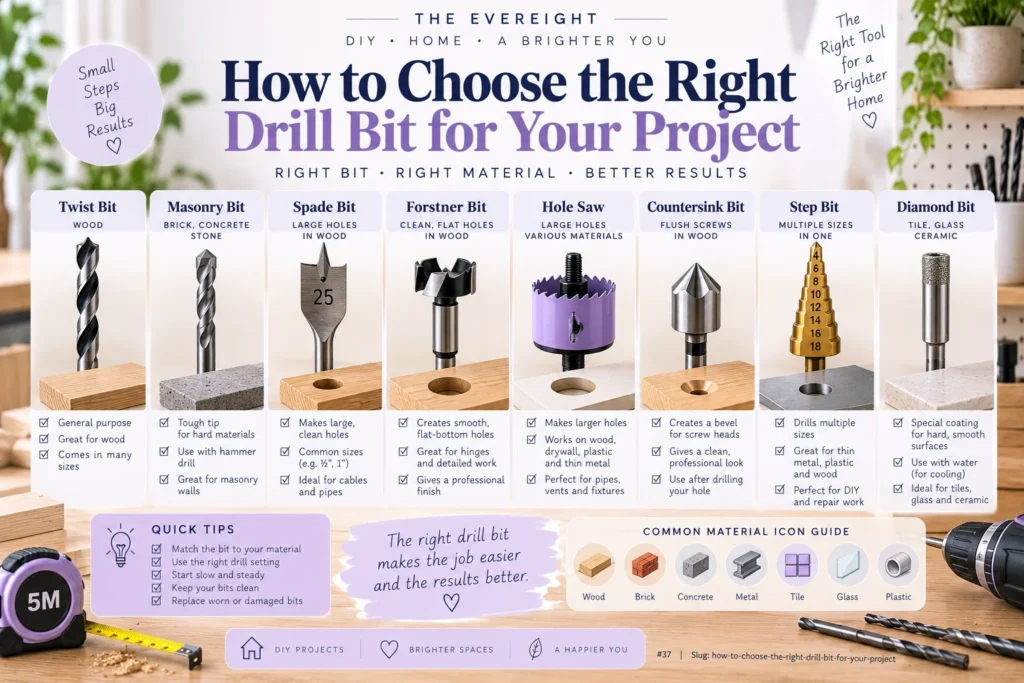
The right drill bit makes drilling easier, cleaner, and safer. The wrong bit can wander, overheat, dull quickly, crack a material, or tempt you to compensate with excessive force.
Beginners often shop by diameter alone. Diameter matters, but so do the material being drilled, the type of hole, the bit’s cutting geometry, its shank, the drill being used, and the manufacturer’s operating guidance.
This guide explains the major bit categories without pretending that one multipurpose set is ideal for every job.
Quick Answer
Choose a bit designed for the material and hole you need, then confirm its diameter, shank, and operating requirements are compatible with your drill. Use wood bits for suitable wood applications, metal-cutting bits for appropriate metals, masonry bits with compatible drilling equipment, and specialty bits for tile, glass, large holes, or clean flat-bottomed holes. Follow the bit and tool manufacturer’s speed, cooling, and safety instructions.
Start With the Material
Ask what you are drilling into.
Common categories include:
- Softwood.
- Hardwood.
- Plywood.
- MDF or other sheet material.
- Metal.
- Masonry or concrete.
- Ceramic or porcelain tile.
- Glass.
- Plastic.
Some bits work across more than one material, but performance and technique can differ.
If you do not know the material, identify it before choosing the accessory.
Twist Drill Bits
Twist bits are the familiar spiral-shaped bits found in many starter sets.
They are widely used for general drilling and are available in different materials and coatings.
Certain twist bits are intended for metal and can also work in some wood or plastic applications, but the best choice depends on hole quality and material.
Do not assume every black, gold, or silver bit has the same composition; manufacturer descriptions matter.
Brad-Point Bits
Brad-point bits are designed for wood.
The center point helps locate the hole accurately, while outer cutting features can produce a cleaner entry than a general twist bit.
They are useful for furniture, dowel work, and woodworking where placement matters.
They are not intended as universal metal or masonry bits.
Spade Bits
Spade or paddle bits make relatively large holes in wood quickly.
They can create more tear-out than cleaner specialty bits.
Support the back of the work where appropriate and follow the manufacturer’s speed recommendations.
Large bits create greater torque demand, so secure the workpiece and maintain control.
Forstner Bits
Forstner-style bits are used for clean, larger-diameter holes in wood and can create flat-bottomed recesses in appropriate applications.
They require stable work support and controlled drilling.
Some sizes are demanding for handheld drills.
Follow the bit and drill capability guidance.
Hole Saws
A hole saw cuts a circular plug rather than removing the entire hole as chips.
Different hole saws are designed for wood, metal, masonry, tile, or other materials.
The arbor and pilot bit must be compatible.
Large hole saws can create substantial reaction torque if they bind.
Use the correct drill, speed, support, and auxiliary handle where required.
Countersink Bits
Countersinks create a recess so a screw head can sit flush or below the surface.
Some tools combine pilot drilling and countersinking.
Choose the size to match the screw and desired result.
Test on scrap because excessive countersinking can weaken the material or create an oversized recess.
Step Drill Bits
Step bits have progressively larger cutting diameters and are commonly used for enlarging holes in suitable thin materials, especially sheet metal.
They are not the default choice for thick lumber.
Secure the workpiece and follow speed and material guidance.
Masonry Bits
Masonry bits use a tip designed to work in materials such as brick, block, or concrete, depending on the bit.
Some are intended for hammer-drill use; others may have different requirements.
Do not use hammer mode unless both the drill, bit, and material support it.
Concrete may contain reinforcement or hidden services.
Dust controls can be important.
Tile and Glass Bits
Tile and glass are specialty materials.
Ceramic, porcelain, stone, and glass can require different bit technologies and cooling or drilling techniques.
Some tile installations conceal waterproofing, pipes, or electrical services.
Use the exact bit manufacturer’s instructions and avoid assuming a generic masonry bit is suitable.
For valuable or difficult tile, professional help may be less costly than a cracked surface.
Auger Bits
Auger bits are designed for larger, deeper holes in wood.
Their screw-like feed point can pull the bit into the material.
That self-feeding action can create significant torque.
They are more appropriate when you understand the drill’s capability and can control the work.
They are not necessary for most first DIY projects.
Driver Bits Are Different
Phillips, slotted, Torx-style, square-drive, hex, and other driver bits turn fasteners rather than drill holes.
The bit must fit the fastener recess accurately.
A worn or wrong-size driver bit can strip the screw.
Impact drivers may require impact-rated driver bits.
Shank Types
Round shank
Common on drill bits used in standard drill chucks.
Hex shank
Can provide convenient bit changes and may fit hex collets when designed for that tool.
SDS-type shanks
Used with compatible rotary-hammer systems.
These are not interchangeable merely because the bit diameter is similar.
Confirm the shank fits the tool.
How to Choose Bit Diameter
For a finished hole, use the required diameter from the project, fastener, anchor, or hardware instructions.
For pilot holes, diameter depends on screw design and material.
For wall anchors, use the bit diameter specified by the anchor manufacturer.
Do not estimate anchor holes by eye.
An oversized hole can compromise holding performance.
Pilot Hole vs Clearance Hole
A pilot hole guides the screw into the receiving material and can reduce splitting.
A clearance hole allows the screw to pass through the first component without its threads engaging, depending on the joint design.
These holes serve different purposes.
Use a proven plan or fastener guidance for joinery where the distinction matters.
Matching Bits to Wall Anchors
The anchor manufacturer should specify:
- Compatible wall material.
- Drill diameter.
- Hole depth.
- Installation procedure.
- Load conditions.
Follow those instructions.
A bit chosen from the anchor’s outside appearance may create the wrong hole.
Bit Length
Longer is not automatically better.
Use enough working length for the required hole while maintaining control.
Extra-long bits can flex and wander.
Deep drilling may require chip clearing or special technique.
Never drill deeper into a wall than necessary without understanding what is behind it.
Bit Material and Coatings
Drill bits may be made from high-speed steel, cobalt-containing alloys, carbide-tipped constructions, or other materials, and may use various coatings.
These labels affect heat resistance, wear, and intended use, but marketing terms can be confusing.
Choose based on the manufacturer’s stated application rather than color alone.
When a Bit Needs Replacement
Replace or service a bit when:
- It is bent.
- It is cracked.
- Cutting edges are damaged.
- It repeatedly overheats despite correct technique.
- It requires abnormal pressure.
- Its shank is damaged.
- A driver bit no longer fits the fastener securely.
Some bits can be sharpened correctly; others are more practical to replace.
Why Bits Overheat
Possible causes include:
- Wrong bit for the material.
- Incorrect speed.
- Excessive pressure.
- Dull cutting edges.
- Poor chip evacuation.
- Lack of required lubrication or cooling.
- Continuous drilling without pauses.
Stop and diagnose rather than pushing harder.
Choosing a Starter Bit Set
A beginner set should cover the materials you actually use.
For basic woodworking, a modest selection of wood-appropriate bits plus common driver bits may be enough.
For metal, masonry, or specialty materials, buy the correct small set when the project appears.
Avoid a giant assortment where most pieces remain unidentified.
Drill-Bit Storage
Keep bits dry and organized by type and size.
Protect cutting edges.
Return bits to labeled positions so you can identify them later.
Do not throw loose sharp bits into a toolbox where they can injure your hand.
Safety Basics
Secure the workpiece.
Wear appropriate eye protection.
Control dust and chips.
Keep hands away from the bit.
Let hot bits cool.
Use the correct drill mode.
Check hidden utilities before drilling installed surfaces.
Use manufacturer-approved accessories and never exceed the tool or accessory’s stated capability.
Common Drill-Bit Mistakes
Choosing by diameter only: Material and geometry are ignored.
Using masonry bits on tile without checking compatibility: The surface may crack.
Using ordinary sockets or bits with an impact tool: The accessory may not be rated for impacts.
Guessing anchor-hole size: Holding capacity can be compromised.
Using a dull bit with more pressure: Heat and loss of control increase.
Buying a huge set without knowing the pieces: Organization becomes confusion.
Editorial Note
Our tool and accessory guides are based on independent research and practical evaluation criteria. Bit materials, coatings, sets, compatibility, and manufacturer recommendations change. Verify current product instructions and tool compatibility before purchasing or use.
EverEight Pro Tip
When you buy a specialty bit, place a small label in its storage case that says the material, required drill mode, and the project you bought it for. Months later, you will not have to identify an unfamiliar bit from appearance alone.
Optional Tool Recommendation
Affiliate disclosure: As an Amazon Associate, The EverEight earns from qualifying purchases.
Amazon Basics Drill & Driver Multi Bit Set: A mixed bit set to consider for compatible drill and driving tasks. Match bit type and size to the material, fastener, and tool. View on Amazon.