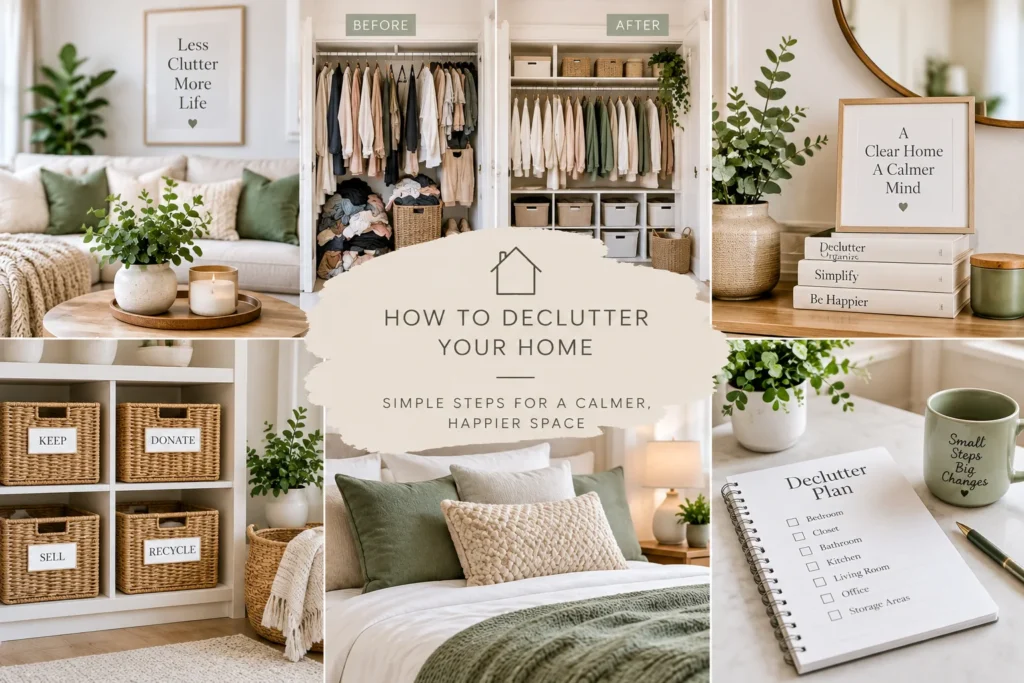
Decluttering is often presented as a dramatic transformation: empty the closet, pile everything on the bed, make hundreds of decisions, and finish with a spotless room. That approach can work for some people, but it can also create a bigger mess and make an already stressful task feel impossible.
A calmer approach is to reduce clutter in controlled passes. You do not need to make every decision today. You need a method that gives you visible progress without taking your home apart.
This guide explains how to declutter your home in small, repeatable steps, how to handle difficult categories, and how to keep momentum when you have limited time or energy.
Quick Answer
To declutter without becoming overwhelmed, start with a small area you can finish in 15 to 30 minutes. Remove rubbish and obvious donations first, return misplaced items, then make decisions about what remains. Use a limited “unsure” container for genuinely difficult decisions. Do not empty an entire room unless you have enough time to put it back together.
Why Decluttering Feels Hard
Clutter is not only a quantity problem. It represents unfinished decisions. A pile may contain something to return, a receipt to file, a toy to repair, clothes to donate, and an object you feel guilty about discarding. Every item can ask a different question.
Decision fatigue is one reason large decluttering sessions become exhausting. Emotional attachment is another. Money spent in the past can make unused objects feel valuable even when keeping them does not recover the cost.
The solution is not to become ruthless. It is to reduce the number of decisions you make at once and begin with the easiest ones.
Step 1: Choose a Finishable Area
Pick a drawer, shelf, countertop, bag, or one section of a closet. Your first target should be small enough that you can restore the area even if your motivation disappears halfway through.
Good starting points include a bathroom drawer, kitchen utensil drawer, entryway surface, one pantry shelf, or one category such as reusable shopping bags.
Avoid beginning with photographs, sentimental keepsakes, inherited possessions, or years of paperwork. Those categories usually require more thought.
Step 2: Use Four Clear Destinations
As you work, give items one of four destinations:
Keep here: the object belongs in this space and deserves a home.
Move elsewhere: you use it, but this is not where it belongs.
Leave the home: donate, sell, recycle, or responsibly discard it.
Decide later: reserve this for genuinely difficult items, not everything you are reluctant to consider.
A laundry basket works well for items that belong elsewhere. Return them after finishing the target area so you do not wander from room to room and become distracted.
Step 3: Remove the Easy Clutter First
Begin with decisions that require almost no emotional effort: rubbish, empty packaging, expired items, broken objects you cannot reasonably repair, obvious duplicates, and things you already intended to donate.
This first pass creates space and gives you a clearer view of the remaining category. It also builds confidence before harder decisions.
Be thoughtful about disposal. Electronics, batteries, medicines, chemicals, and some household materials require specific disposal or recycling methods depending on where you live.
Step 4: Ask Better Questions
“Does this spark joy?” is useful for some people, but practical households often need more specific questions.
Try:
- Do I use this now?
- Would I notice if it disappeared?
- Does it fit my current home, body, work, hobbies, or routines?
- Do I own another item that performs the same job better?
- Would I buy this again today?
- Am I keeping it because I want it, or because I feel guilty?
- Is the storage space it consumes worth the value it provides?
You do not need to justify keeping every possession. The questions simply help distinguish intentional belongings from objects kept by default.
Step 5: Declutter by Category When It Helps
Room-by-room decluttering is easy to manage, but categories are useful when duplicates are spread throughout the house.
If you have stationery in four rooms, gathering it together can reveal that you own far more than you realized. The same applies to cleaning products, reusable bottles, cables, toiletries, tools, and gift wrap.
Do not gather a massive category unless you have time to complete it. “All clothing” may be too large; “all T-shirts” is manageable.
Decluttering the Kitchen
Start with expired food and obvious rubbish. Then look at duplicates and single-purpose gadgets.
Ask whether cookware fits how you actually cook. A large serving dish used twice a year may deserve storage; five nearly identical utensils may not.
For food-storage containers, match lids and bases. Recycle or repurpose unmatched pieces when appropriate. Avoid keeping an enormous number “just in case” if they make the cabinet unusable.
Do not reorganize the pantry before reducing expired and unwanted food. Organizing unnecessary inventory only makes it look neater.
Decluttering Clothing
Clothes can carry identity, memories, money, and hopes about future size or lifestyle, so work slowly.
Start with damaged items you will not repair and clothes you already avoid wearing. Then review fit, comfort, condition, and usefulness.
Create a small repair or alteration category only if you will realistically act on it. Give it a deadline. A permanent bag of “clothes to fix someday” is simply another form of storage.
If you are uncertain about an item, wear it for a normal day. Real use often gives you better information than staring at it on a hanger.
Decluttering Paper
Paper requires separating information from the physical sheet.
Begin with obvious recycling: outdated flyers, duplicate papers, envelopes, and nonessential notes. Then separate action papers from records that need retention.
Do not discard legal, tax, financial, medical, property, identity, or warranty documents without understanding applicable retention requirements. Rules vary by document and location.
Create a small action tray for papers requiring payment, response, filing, or another next step. A filing cabinet full of unresolved tasks is not an effective system.
Decluttering Sentimental Items
Sentimental decluttering should rarely be your first project. Build your decision-making skills elsewhere first.
Remember that the memory and the object are related but not identical. You may keep meaningful items intentionally while letting go of others from the same period.
Consider selecting representative pieces rather than every object. Photographing an item before releasing it can help when the visual memory matters more than possession, although photographs can become digital clutter too.
Never pressure another household member to discard sentimental belongings simply because you do not share the attachment.
What About Gifts?
A gift fulfilled its original purpose when it was given. Keeping something you do not use is not the only way to appreciate the person who gave it.
If letting go feels uncomfortable, acknowledge the intention behind the gift and decide whether the object still belongs in your life. You can be grateful and still donate something that another person may use.
What About Things You Paid a Lot For?
Past spending is a sunk cost: keeping an unused object does not return the money.
Selling may recover some value, but selling also requires photographs, listings, messages, storage, and time. Set a threshold. You might sell only items likely to justify the effort and donate lower-value objects.
If you decide to sell, give yourself a deadline. Items that remain in a “to sell” pile for six months have not actually left your home.
The “Maybe Box” Without Creating Permanent Clutter
An uncertainty box can reduce pressure, but it needs boundaries. Use one container, label it with a review date, and avoid filling multiple rooms with undecided items.
When the review date arrives, notice what you missed or needed. Items you forgot existed may be easier to release. Some objects will still deserve to stay, and that is fine.
Decluttering When You Have Only 15 Minutes
Short sessions are surprisingly effective when the target is specific.
Choose one task: remove expired bathroom products, clear one countertop, match food containers, review ten shirts, or process one stack of paper.
Spend the final two or three minutes restoring the area and moving donations to a designated exit point. A session that ends with a usable space is more motivating than one that leaves piles behind.
Decluttering With Children or Other Household Members
Shared possessions require shared decisions. Establish clear boundaries around personal belongings and common spaces.
For children, broad categories and physical limits can help. Instead of asking a child to eliminate half their toys, ask which toys they still enjoy and which could be passed to someone else. A container can define how many objects comfortably fit without turning the process into punishment.
Adults may have different clutter tolerances. Agree on functional standards for shared surfaces rather than expecting identical personal preferences.
Common Decluttering Mistakes
The first mistake is removing everything from a large room without a completion plan. The second is buying storage during the decluttering stage. Another is creating dozens of piles that become new clutter.
Avoid making emotionally difficult decisions when you are tired. Avoid using shame as motivation. And do not judge success by the number of bags removed; the real goal is a home that supports your life.
What to Do With Items Leaving Your Home
Create an exit route before you begin. Know where donations can go, which materials can be recycled locally, and which items require special disposal.
Move donation bags out promptly. A bag sitting in a hallway for weeks is still household clutter.
For valuable items, decide whether selling is worth your time. For items in poor condition, do not shift the burden to a charity. Donate things that are appropriate for the organization receiving them.
How to Know When You Have Decluttered Enough
You do not need empty shelves. You need enough space for your possessions to be accessible and maintainable.
You may be finished when drawers close without force, frequently used objects are easy to reach, surfaces can serve their intended purpose, and putting things away does not require rearranging several other things.
The right amount is personal. The objective is not to own the least. It is to stop managing possessions that no longer provide enough value to justify their space and attention.
EverEight Pro Tip
When you get stuck, stop asking “Should I get rid of this?” and ask “If I keep this, where exactly will it live?” Requiring a real storage location turns an abstract emotional decision into a practical one.