Affiliate disclosure: As an Amazon Associate I earn from qualifying purchases.
Pantry organization products are easy to overbuy. A coordinated wall of containers can look impressive, yet still make groceries harder to put away, hide package information, or consume more shelf space than the original food.
The best pantry organizer is therefore not the most attractive product or the largest set. It is the simplest tool that fixes a specific access, visibility, containment, or space problem in your pantry.
This guide compares the pantry-organization product types that are usually most useful, explains when each one earns its space, and shows what to measure before buying. It is deliberately category-first rather than brand-first because dimensions, materials, prices, and product availability change. Specific models should be verified immediately before publication or recommendation.
Quick Verdict
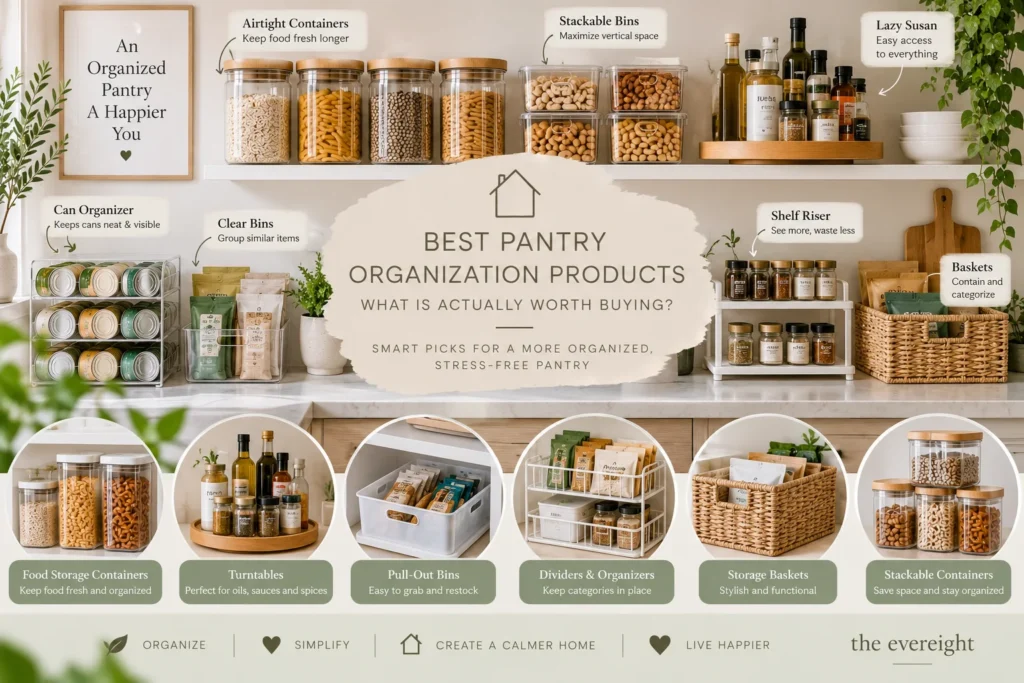
For most pantries, start with only three things: a few appropriately sized open bins for loose packets, a shelf riser where vertical space is wasted, and a turntable only in a deep corner where bottles or jars are hard to reach. Airtight food-storage containers are worthwhile for selected dry staples, not automatically for every package.
If your pantry is already easy to scan and everything has a home, you may need no new products at all.
Before Buying Anything: Diagnose the Pantry
Stand in front of the pantry and name the actual problem.
If cans disappear behind one another, you have a visibility problem. If snack packets collapse into a heap, you have a containment problem. If there is a large gap above a row of short jars, you have unused vertical space. If oils at the back require unloading the shelf, you have an access problem.
Write the problem down before shopping. This simple step prevents an organizer from becoming another object you need to organize.
Measure the usable width, depth, and height of the shelf. Check hinges, shelf lips, door frames, handles, pipes, and anything else that reduces clearance. For pull-out products, measure the space required to extend them, not just the space they occupy when closed.
Best Overall for Loose Categories: Open Pantry Bins
Example product: Vtopmart 6-Pack Clear Stackable Storage Bins with Lids and Handles. Check the dimensions and whether the lids suit your access needs before choosing this style.
Open bins are one of the most versatile pantry products because they create a boundary without requiring every item to be decanted.
Best for
Snack packets, baking packets, lunch supplies, drink mixes, small boxes, pouches, and lightweight backstock.
Why they work
A bin turns several small packages into one movable category. Instead of searching behind boxes, you can pull out the entire snack or baking group.
Clear sides can improve visibility. Handles are helpful on deeper shelves. Open tops make grocery put-away fast.
What to check
Choose a bin that leaves enough clearance to grip and remove it. Very deep bins can become heavy and hide food at the bottom. Stackable bins are useful only if you can still access the lower bin conveniently.
Skip them when
Your products already stand neatly in visible rows or the bin would waste shelf width. Do not put a bin around a category simply because every other shelf has one.
Best for Wasted Shelf Height: Shelf Risers
Products to compare: These examples may help you evaluate size, access and fit for your own pantry.
Shelf risers create a second level within a tall shelf.
Best for
Cans, short jars, small boxes, mugs, or other items that leave a large unused gap above them.
Why they work
They use vertical space while keeping the lower and upper levels visible. A riser can be especially effective in a cabinet pantry where shelf spacing cannot easily be changed.
What to check
Measure both the height below the riser and the total shelf clearance. Check the product’s load guidance and stability. A riser that flexes under heavy jars is not a good solution.
Choosing Pantry Organizers for Heavy Items
For heavy cans, glass jars, bulk ingredients or appliances, compare the manufacturer’s stated weight capacity, shelf dimensions, construction and installation requirements before comparing prices. A sturdy fixed shelf or appropriately rated pull-out organizer may be more suitable than a lightweight plastic bin or an unsupported riser. Never assume that a product marketed as heavy-duty has a verified load rating.
Check whether the published capacity applies to each shelf, the entire organizer or a fully installed unit. Consider the weight of the contents and the organizer itself, and follow the manufacturer’s mounting and load-distribution instructions. If a listing does not specify a trustworthy capacity, avoid recommending it for unusually heavy storage.
Skip them when
Your pantry shelves are adjustable. Moving a shelf may solve the same problem for free and create a sturdier result.
Best for Deep Corners: Turntables
Products to compare: These examples may help you evaluate size, access and fit for your own pantry.
A turntable, often called a lazy Susan, brings items at the back of a shelf to the front with a spin.
Best for
Oils, vinegars, sauces, jars, spreads, small bottles, and condiments.
Why they work
Round storage sacrifices some rectangular shelf area, but it can dramatically improve access in a deep corner. That tradeoff is worthwhile when items otherwise disappear.
What to check
Measure diameter and shelf depth. Make sure the tallest bottle clears the shelf above. A raised edge helps keep items contained, while a non-slip surface can reduce movement.
Skip them when
The shelf is shallow or narrow. A circle inside a tight rectangle can waste useful corners. Boxes and rectangular packages also tend to fit poorly on a turntable.
Best for Dry Staples: Airtight Food-Storage Containers
Products to compare: Vtopmart 24-Piece Airtight Food Storage Containers and Skroam 4-Pack Airtight Cereal Storage Containers. Compare capacity and lid design before buying.
Airtight containers can be useful, but they are the pantry category most likely to be purchased as an oversized matching set.
Best for
Frequently used dry staples whose original packaging is difficult to reseal, store, pour, or protect appropriately.
Why they work
Rigid containers can stack neatly, make quantities visible, and improve handling of flour, sugar, rice, oats, pasta, cereal, and similar foods when the container is suitable for that food.
What to check
Confirm that the container is intended for food contact and for the type of storage you plan. Look at usable capacity rather than exterior size alone. Check whether the lid is easy to clean and whether replacement parts are available if that matters to you.
Preserve important information from original packaging, including allergen information, preparation instructions, dates, and lot details when relevant.
Skip them when
The original package is already sturdy, resealable, compact, and easy to identify. Decanting every item adds work and can make food harder to track.
Best for Cans: Tiered Risers or Can Organizers
Products to compare: These examples may help you evaluate size, access and fit for your own pantry.
Cans create a particular visibility problem because identical tops hide labels.
Tiered risers
A stepped riser elevates the back rows so labels are easier to see. It is flexible because it can hold jars and spices too.
Dedicated can dispensers
These can hold more cans in a compact footprint and may rotate older cans forward, but they are less flexible if your can sizes vary.
What to check
Measure can diameter, organizer width, and shelf height. Consider whether you can remove a can without disturbing the stack.
For most households, a simple tiered riser is the more adaptable first purchase.
Best for Deep Lower Shelves: Pull-Out Bins or Drawers
Products to compare: These examples may help you evaluate size, access and fit for your own pantry.
Deep shelves often look spacious but are difficult to use because the back becomes inaccessible.
A pull-out bin converts depth into a drawer-like motion. It is useful for baking supplies, packets, small appliances, or grouped pantry items.
Check the shelf lip, hinges, and clearance. Adhesive or mounted systems should be installed exactly as directed, and any load rating should be respected.
A basic handled bin can provide much of the same benefit without installation.
Best for Narrow Packets: Divided Bins
Packets of seasoning, drink mixes, snacks, and small baking ingredients tend to slump together.
A narrow divided bin can keep them upright. The key is choosing broad divisions rather than creating a separate slot for every flavor or brand.
If your packet collection changes frequently, removable dividers are more flexible than fixed compartments.
Best for Spices: Tiered Shelf, Drawer Insert, or Turntable
Products to compare: These examples may help you evaluate size, access and fit for your own pantry.
There is no single best spice organizer because the right solution depends on where your spices live.
A tiered shelf works in a cabinet when you need to read labels at a glance. A drawer insert works well when you have a shallow drawer near the cooking area. A turntable helps in a deep cabinet.
Before buying, measure your actual spice jars. Specialty jars vary widely.
Do not automatically transfer spices into matching containers. If you do, label them carefully and preserve relevant product information.
Best for Pantry Doors: Shallow Door Organizers
Products to compare: These examples may help you evaluate size, access and fit for your own pantry.
The back of a pantry door can create storage without taking floor space.
Best for
Lightweight packets, wraps, small jars, or other shallow items.
What to check
The organizer must clear shelves when the door closes. Check door construction, hinge capacity, mounting instructions, and the depth of stored items.
Skip them when
The door is unsuitable, the rack interferes with closure, or the added weight creates a problem.
Best Low-Cost Upgrade: Labels
Products to compare: These examples may help you evaluate size, access and fit for your own pantry.
Labels are valuable when they answer a question.
Use them on opaque bins, decanted foods, backstock, and broad zones. “Baking” or “lunch” is usually more maintainable than labels for every individual product.
Labels should make the system easier for the whole household, not turn grocery put-away into a filing exercise.
Best No-Purchase Upgrade: Adjustable Shelves
Before ordering risers, inspect the shelf pin holes in your pantry or cabinet.
If shelves can move, adjust the spacing around what you actually store. Reducing a large gap above cans may create enough room for an entirely new shelf.
This is one of the highest-value pantry improvements because it may cost nothing.
Pantry Organizer Comparison
Open bins: Best for grouping loose packages. Flexible and easy to maintain, but oversized bins can hide food.
Shelf risers: Best for unused vertical space. Excellent for short items, but must be stable and properly sized.
Turntables: Best for deep corners and bottles. Great access, but inefficient on narrow rectangular shelves.
Airtight containers: Best for selected dry staples. Improve stacking and handling, but require decanting and labeling.
Tiered organizers: Best for cans, jars, and spices. Improve visibility, but need enough vertical clearance.
Pull-out bins: Best for deep shelves. Improve access, but require clearance and can become heavy.
Door organizers: Best when shelf space is scarce. Add capacity, but only if the door can safely accommodate them.
What Is Usually Not Worth Buying?
Giant matching container sets
They often include sizes you do not need. Buy for the foods you actually decant.
Highly specific organizers
A holder designed for one package size may become useless when your shopping habits change.
Decorative baskets that hide everything
Opaque baskets can look calm, but they require labels and good category discipline. For food, visibility is often more useful than visual uniformity.
Organizers that add an extra step
If you must remove a lid, pull out a bin, open another container, and then replace everything to grab a daily snack, the system is too complicated.
Products bought before measuring
Even an excellent organizer is a bad purchase if it blocks a hinge or wastes several inches of shelf depth.
How Much Should You Buy at Once?
Start with one problem area. Buy or test one type of solution. Use it through at least one normal grocery cycle before expanding the system.
This approach reveals whether the organizer works when the pantry is full, when multiple people put groceries away, and when your usual products change.
It also prevents the expensive mistake of designing the pantry around containers rather than food.
Materials: Plastic, Glass, Metal, or Natural Baskets?
For direct food storage, choose containers designed for food contact and follow their care instructions. Glass is transparent and non-porous but heavier and breakable. Plastic is lightweight and available in many shapes but varies in durability and care requirements.
For packaged-food bins, material is more about cleaning, visibility, weight, and style. Wire baskets provide airflow and visibility but do not contain tiny packets well. Woven baskets hide visual clutter but can be harder to wipe clean.
There is no universally superior material. Match it to the job.
A Better Buying Checklist
Before purchasing a pantry organizer, answer these questions:
- What exact problem will it solve?
- What are the usable shelf dimensions?
- Will it still work when full?
- Can everyone who needs it reach and use it?
- Can it be cleaned easily?
- Does it hide food or improve visibility?
- Does it require decanting?
- Is it flexible enough for changing grocery sizes?
- Is the material appropriate for the intended use?
- Could rearranging or decluttering solve the problem for free?
If you cannot answer the first question, wait.
Editorial Note
Our reviews and buying guides are based on independent research and practical evaluation criteria. We aim to provide honest, accurate, and useful information to help readers make informed decisions. Product availability, dimensions, materials, and pricing can change, so verify current specifications with the manufacturer or retailer before purchasing.
EverEight Pro Tip
Do a “cardboard test” before buying bins. Cut or fold spare cardboard to the organizer’s listed footprint and place it on the shelf. You will immediately see how much usable space remains and whether the organizer can actually be pulled out around hinges or neighboring items.