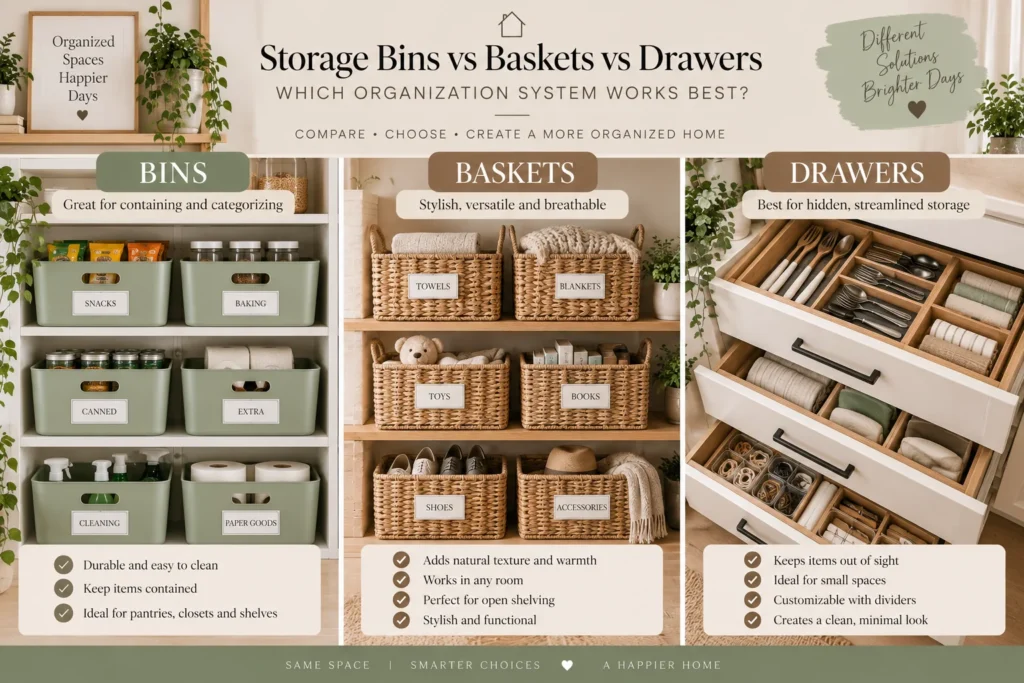
Storage bins, baskets, and drawers can all create order, but they solve different problems. A clear bin is excellent when you need to see packaged food. A woven basket can hide visual clutter in a living room. A drawer is usually better for small items you need to access individually.
Choosing by appearance alone is where organization systems often fail.
This guide compares bins, baskets, and drawers by access, visibility, cleaning, flexibility, weight, and typical use so you can choose the simplest system for the category you are storing.
Quick Verdict
Choose bins when you need flexible category storage, easy removal, or visibility. Choose baskets when quick open access and a softer appearance matter, especially for lightweight household items. Choose drawers when you need frequent access to small items without lifting or removing a container.
For many homes, the best system is mixed: drawers for small daily items, bins for grouped categories, and baskets for open-room storage.
Storage Bins: Best for Flexible Categories
A storage bin is usually a rigid or semi-rigid container designed to group items on a shelf, in a cabinet, or inside a larger storage area.
Advantages of bins
Bins are flexible. You can move an entire category at once, use them inside deep cabinets, and select clear versions when visibility matters.
They work well for pantry packets, cleaning cloths, craft supplies, toiletries, children’s categories, office supplies, and backstock.
Lidded bins can protect rarely used contents from dust, while open bins make everyday access faster.
Disadvantages of bins
Deep bins can hide objects at the bottom. Large bins become heavy. A row of bins can also waste shelf space if their dimensions do not match the cabinet.
Lids add an extra step, so lidded bins are often poor choices for objects accessed several times a day.
Best places for bins
Pantries, linen closets, under sinks, utility rooms, children’s storage, hobby areas, and deep shelves.
Storage Baskets: Best for Easy Open Access and Visual Warmth
Baskets perform many of the same jobs as bins but often prioritize open access and appearance.
They may be woven from natural fibers, fabric, wire, plastic, or other materials.
Advantages of baskets
Open baskets are quick to use. They can make blankets, toys, books, towels, or accessories feel intentionally contained without hiding them behind a drawer front.
A basket can also soften the look of open shelving in living areas.
Disadvantages of baskets
Opaque baskets hide contents and therefore need clear categories or labels. Woven surfaces can be harder to clean than smooth plastic. Some baskets snag delicate fabrics, and flexible fabric baskets may collapse when only partly full.
Natural materials may not suit damp or messy areas.
Best places for baskets
Living rooms, bedrooms, entryways, linen storage, shelves, and toy areas where open access matters.
Drawers: Best for Frequent Individual Access
Drawers allow you to access contents without lifting the container off a shelf.
Advantages of drawers
They are excellent for small items because the entire storage plane comes toward you. Drawer dividers can separate stationery, utensils, cosmetics, tools, cables, or clothing accessories.
Stackable drawer units can also turn a shelf into multiple accessible levels.
Disadvantages of drawers
Drawers need clearance to open. They are less portable than bins and may have fixed dimensions that do not adapt when categories change.
Low-quality drawer units can flex or jam under weight. Deep drawers can become junk drawers unless divided.
Best places for drawers
Desks, kitchens, bathrooms, closets, craft areas, workshops, and any space where small items are accessed frequently.
Bins vs Baskets: What Is the Real Difference?
The terms overlap, but the practical distinction is usually material and use.
Bins tend to be rigid, washable, and available in clear designs. Baskets often have open tops and are chosen partly for how they look in visible rooms.
For a pantry, a clear bin may be better because you can see food and wipe spills. For a living-room blanket collection, a woven basket may blend into the room more naturally.
If both products are opaque and similarly shaped, function may be almost identical. Choose based on cleaning, handles, dimensions, and durability rather than the label.
Bins vs Drawers: Which Is Easier to Access?
Drawers win for frequent individual access. You pull the drawer open and select one item.
Bins are better when the whole category moves. A baking bin can be carried to a counter. A cleaning caddy can travel to another room.
On a high shelf, a lightweight handled bin may be easier than a drawer because you can bring the category down to eye level. On a low deep shelf, a drawer may prevent repeated bending and reaching.
Baskets vs Drawers: Which Looks Better in Living Areas?
This is subjective, but baskets are often designed to remain visible. They can add texture while containing blankets, toys, or accessories.
Drawers create stronger visual concealment. A closed drawer removes the category from view completely.
Choose according to how the room is used. If children need to toss toys away quickly, an open basket may outperform a beautiful drawer unit they rarely open.
Comparison by Storage Need
Visibility
Best: Clear bins.
Baskets and closed drawers usually hide contents. Labels or consistent categories become more important.
Fast access
Best: Open baskets for large items; drawers for small individual items.
Lidded bins are slowest when accessed frequently.
Portability
Best: Bins or baskets with comfortable handles.
Drawers generally stay in place.
Cleaning
Best: Smooth washable bins or drawer inserts.
Woven natural baskets can trap dust and crumbs.
Visual concealment
Best: Closed drawers or opaque baskets.
Clear bins show everything, which is useful but visually busy.
Flexibility
Best: Standalone bins and baskets.
They can change rooms or categories more easily than fitted drawers.
Stacking
Best: Purpose-designed lidded bins or drawer units.
Never stack containers in ways that are unstable or exceed product guidance.
Which Is Best for the Pantry?
Usually clear open bins.
They group packets without requiring decanting and make stock easier to see. Use turntables or risers for categories that bins do not solve.
Drawers can be excellent in deep lower pantry shelves. Decorative baskets are better for packaged categories that do not spill and when visibility is less important.
Food stored directly in a container requires a product intended for food contact; a general storage bin is not automatically suitable for loose food.
For practical product examples, see our pantry organization product guide, which includes clearly disclosed Amazon affiliate recommendations.
Which Is Best for the Bathroom?
Drawers and washable bins usually perform well because bathroom products are small and spills happen.
Use shallow containers so products do not disappear. In damp environments, choose materials appropriate for the conditions.
Keep plumbing accessible and follow storage instructions for medicines and personal-care products.
Which Is Best for the Living Room?
Baskets are often the easiest fit for blankets, toys, magazines, or hobby supplies because they combine quick access with a home-friendly appearance.
Drawers are better for small electronics, cables, game accessories, or anything that looks visually busy.
Use bins inside closed cabinets where appearance is irrelevant.
Which Is Best for Children’s Toys?
Open bins and baskets make cleanup simple.
Use broad categories rather than dozens of tiny ones. Choose containers that children can safely reach and handle.
Drawers can work for art supplies or small building pieces when children are old enough to use the system comfortably.
Furniture should be secured appropriately, and heavy containers should not be stored where they can fall.
Which Is Best for Clothes?
Drawers are excellent for underwear, socks, sleepwear, and folded clothing.
Baskets can hold accessories or clothes to wear again. Lidded bins are useful for seasonal storage, especially under beds or on less-accessible shelves.
Avoid overfilling containers. Clothing is easier to maintain when you can remove one item without disturbing everything else.
Which Is Best for a Home Office?
Drawers are usually best for frequently used stationery and small equipment.
Bins work for project supplies, cables, printer supplies, or archived categories. Baskets can hold notebooks or incoming paper if the category is processed regularly.
Paper that requires action should not disappear into a deep basket.
Clear vs Opaque Storage
Clear storage reduces the need for labels and is useful for food, craft materials, or household supplies where stock levels matter.
Opaque storage creates visual calm and protects unattractive categories from view.
The tradeoff is memory. If you cannot see inside, the label and location need to be clear enough that the category does not disappear.
A useful compromise is opaque storage in visible living areas and clear storage inside closets and cabinets.
Open vs Lidded Storage
Open storage reduces friction. It is best for daily-use items.
Lids protect from dust and allow certain containers to stack, but they add a step. Use them for seasonal, archival, or infrequently accessed categories.
A common organization mistake is using lids everywhere because the containers look tidy when closed. If household members constantly leave the lids off, the system is telling you it wants to be open.
How to Measure Before Buying
Measure the inside of the shelf or cabinet, not the outside.
Record width, depth, and usable height. Check hinges, trim, shelf lips, and door clearance.
For drawers, measure the space required to open fully. For baskets and bins, leave room for your hands or handles.
If you plan to place several containers side by side, multiply their external widths and allow a little tolerance. Product dimensions can vary, so verify current specifications before purchasing.
Should Every Container Match?
No.
Matching containers can make open shelving look calmer, but a uniform appearance is not the same as an effective system.
A mixed system may perform better: clear bins in the pantry, washable drawers in the bathroom, and woven baskets in the living room.
If you want visual consistency, repeat a limited material or shape within one room rather than forcing the entire home into a single container system.
When You Should Buy Nothing
If the category fits comfortably on a shelf, remains visible, and is easy to put away, a container may make it worse.
Containers are tools for boundaries and access. They are not mandatory.
Sometimes the best solution is removing duplicates, adjusting a shelf, or relocating the category closer to where it is used.
Editorial Note
Our reviews and comparisons are based on independent research and practical evaluation criteria. We aim to provide honest, accurate, and useful information to help readers make informed decisions. Product specifications and availability can change; verify current dimensions, materials, care instructions, and intended use before purchasing.
EverEight Pro Tip
Choose the container by the motion you want to make. If you want to grab one thing, choose a drawer or open basket. If you want to move the whole category, choose a handled bin or basket. Designing around the physical action makes the system easier to maintain.