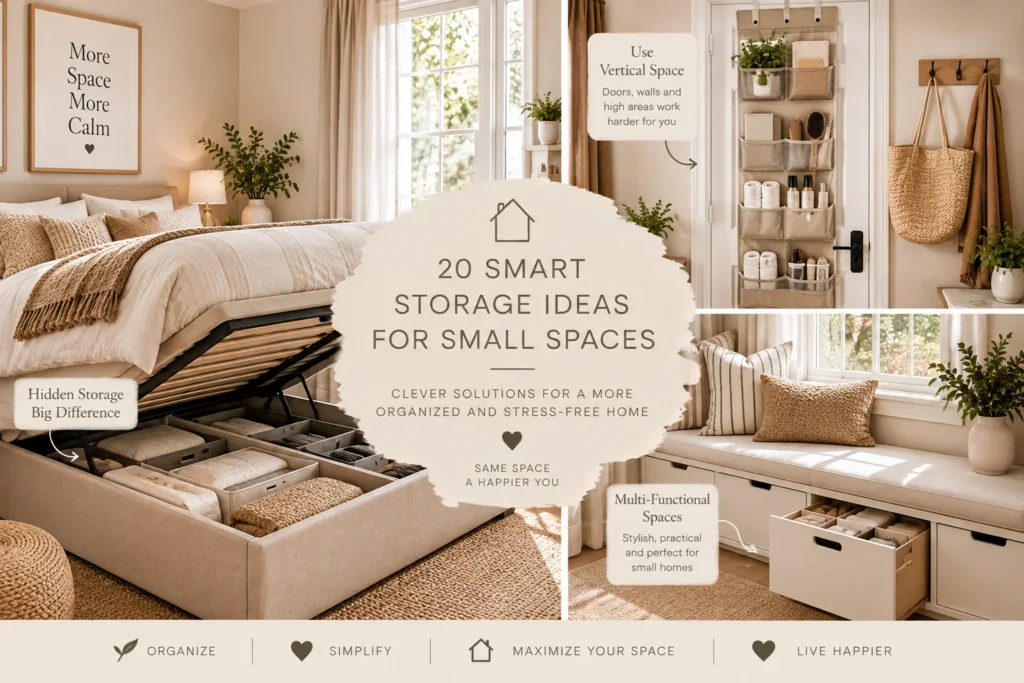
Small spaces reward thoughtful storage, but they also punish over-storage. Adding a cabinet, basket, or shelf to every available surface can technically increase capacity while making the room harder to move through and more visually crowded.
Smart storage does something different: it uses an overlooked area, improves access to an existing area, or lets one piece of furniture perform two useful jobs.
These 20 ideas work across apartments, small houses, bedrooms, kitchens, bathrooms, and multipurpose rooms. Use only the ones that solve a real problem in your space.
1. Use Wall Height, Not Just Floor Width
Tall storage makes better use of a small footprint than short, wide furniture.
A tall bookcase, wall-mounted shelving, or vertical rail system can move books, supplies, and lightweight household items off surfaces.
Secure tall furniture appropriately and follow mounting and load instructions. Keep heavier objects on lower levels.
2. Add Hooks at the Point of Use
Hooks are among the simplest small-space tools because they need little depth.
Place them where objects naturally land: bags near the door, robes near the bed, towels near the shower, or lightweight tools near a workspace.
Do not install hooks where hanging items narrow a walkway or interfere with doors.
3. Use the Back of a Suitable Door
An over-door organizer can create storage in a bedroom, pantry, bathroom, or utility area.
Choose shallow items and check clearance. The door should still close easily, and the added weight should be appropriate for the door and hardware.
This is especially useful in rentals because some systems require no permanent installation, though you should still protect the door surface.
4. Turn Under-Bed Space Into Real Storage
Under-bed space is ideal for seasonal clothing, spare bedding, shoes, or occasional items.
Use containers that can be pulled out easily. Measure both the height under the bed and the clearance needed to slide the container past nearby furniture.
Label opaque boxes. Avoid pushing loose items underneath, where they become invisible clutter.
5. Choose a Bed With Built-In Drawers
If you are replacing a bed anyway, built-in drawers can eliminate the need for a separate dresser in some rooms.
Before buying, check whether drawers can fully open given the room layout. A storage bed placed inches from a wall or nightstand may have unusable drawers.
Lift-up beds can offer large capacity but require comfortable, safe operation and enough clearance.
6. Use an Ottoman or Bench With Storage
A storage ottoman can combine seating, a footrest, and a home for blankets, games, or other lightweight items.
A storage bench can work in an entryway or bedroom.
Do not choose an oversized piece simply because it stores more. In a small room, walking space is part of the furniture calculation.
7. Add a Shelf Above a Desk
The wall above a desk is often unused while the desktop becomes crowded.
A properly mounted shelf can hold reference books, lightweight supplies, or a few containers. Keep daily items within easy reach and archive items higher.
Avoid overhead placement of heavy objects that could fall.
8. Use Vertical File Holders for More Than Paper
Magazine files can store slim categories such as notebooks, reusable bags, small cutting boards, or craft materials where appropriate.
The vertical format keeps items from becoming a horizontal pile and makes individual pieces easier to remove.
Label the holder if the contents are not obvious.
9. Divide Tall Cabinet Shelves
For food-cabinet and pantry examples, our pantry organization product guide compares practical storage options and includes disclosed Amazon affiliate links.
A shelf riser can create two levels inside a cabinet where short objects leave empty air above them.
Use risers for dishes, cans, mugs, toiletries, or small supplies depending on the room.
If the cabinet shelf itself can be adjusted, try moving it first. Free solutions deserve priority.
10. Convert Deep Shelves Into Pull-Out Categories
Depth is useful only when you can reach it.
Use handled bins or appropriately installed pull-out drawers to bring the back of a deep shelf toward you. This works in pantries, linen closets, bathroom cabinets, and craft storage.
Keep each bin to one broad category so you can pull out exactly what you need.
11. Use Narrow Gaps Carefully
A slim cart or narrow shelving unit may fit beside a refrigerator, washer, desk, or bathroom vanity.
Measure the entire path, not just the gap. Check baseboards, handles, door swing, ventilation requirements, and whether the cart can be removed for cleaning.
Never block appliance ventilation or required service clearance.
12. Store Suitcases Inside One Another
Empty luggage consumes a surprising amount of volume.
Nest smaller suitcases or travel bags inside larger ones when materials and shapes allow. You can also store travel-only items inside, such as packing cubes.
Do not fill luggage with unrelated household items that you will forget before the next trip.
13. Use the Top Shelf for Low-Frequency Categories
Prime storage should go to frequent-use items.
Move seasonal décor, guest linens, archives, or special-occasion items to higher shelves when they can be stored and retrieved safely.
Use labels so you do not need to open every box.
14. Create One Controlled “Backstock” Area
Extra toiletries, paper goods, pantry staples, and cleaning supplies can spread throughout a small home.
Choose one defined backstock area. When it is full, use what you own before buying more.
This keeps bulk purchasing from quietly consuming living space.
15. Use Furniture With Shelves Instead of Solid Bases
When choosing a coffee table, side table, or console, a lower shelf can add useful storage without increasing the footprint.
Use it for categories that belong in the room, such as books or a basket of remotes and accessories.
Avoid filling every open shelf. Some negative space helps a small room feel calmer.
16. Build a “Mobile Zone” With a Rolling Cart
A cart can turn one small footprint into a mobile craft station, office supply unit, beauty station, or hobby area.
The cart works best when the activity happens in multiple places and the cart has a permanent parking location afterward.
If it is always blocking something, the mobility is not an advantage.
17. Use Closet Doors and Side Walls
Closet storage is not limited to the back wall.
Narrow hooks or suitable mounted organizers on side walls can hold belts, accessories, lightweight bags, or small supplies. Door-mounted storage may work too if it clears the closet contents.
Plan around the door’s movement and the depth of hanging clothes.
18. Store by Activity, Not Just Object Type
In a multipurpose home, grouping everything by object type can create extra movement.
A “school morning” zone might include approved lunch supplies, reusable bottles, and bags. A “work from home” box might contain the equipment needed to convert a dining table into a temporary desk.
Activity-based storage is particularly useful when one room performs several jobs.
19. Digitize Appropriate Paper – With a Real System
Scanning suitable papers can reduce physical filing, but only if digital files become easier to retrieve.
Use consistent file names, folders, and backups. Protect sensitive information appropriately.
Do not destroy originals that must be retained. Legal and record-retention requirements vary.
20. Leave Some Storage Empty
This may be the most important small-space idea.
A drawer that is 80 or 90 percent full is easier to use than one packed to its physical limit. A closet with a little free rail space can accept laundry without a wrestling match.
Empty capacity allows the home to absorb normal change: groceries, gifts, a new hobby, seasonal clothing, or a temporary project.
How to Find Hidden Storage Without Making the Home Feel Smaller
Walk through the home and look for areas that are currently empty but could hold storage without reducing movement.
Good candidates may include vertical wall space, under-bed space, the inside of a suitable door, the upper portion of a closet, or the lower shelf of existing furniture.
Bad candidates are usually walkways, ventilation zones, access panels, crowded countertops, or any location that makes daily objects harder to retrieve.
The goal is not to discover every possible cubic inch. It is to find the few unused areas that improve function.
Small-Space Storage by Room
Entryway
Prioritize keys, daily shoes, bags, and outgoing items. A narrow shoe solution, a few hooks, and a small tray may be enough.
Kitchen
Protect counter space. Use adjustable shelves, risers, vertical dividers, and pull-forward storage inside cabinets.
Bedroom
Use under-bed space and closet height. Give worn-again clothes a hook so they do not become chair clutter.
Bathroom
Use shallow storage and vertical space while keeping plumbing accessible. Store products according to their instructions.
Living room
Choose furniture that earns its footprint. Hide visually busy categories while keeping frequently used objects easy to reach.
Home office
Use the wall above the desk and keep the desktop limited to current work. Archive supplies and papers outside prime reach.
Storage Products Worth Considering
A product is worth considering when it improves one of four things: access, visibility, containment, or use of height.
Useful categories include hooks, shelf risers, shallow under-bed containers, handled bins, drawer dividers, narrow shelving, and appropriately sized multipurpose furniture.
Measure before buying. Product dimensions are often external dimensions, while usable interior capacity may be smaller.
Small-Space Storage Mistakes
Buying before decluttering: You may create storage for things you do not need.
Blocking access: Storage should not cover plumbing, electrical panels, ventilation, or necessary appliance clearance.
Going too vertical: High storage is not useful if it cannot be accessed safely.
Using oversized bins: A large bin can hide objects and become too heavy to move.
Choosing furniture only for storage capacity: The room still needs comfortable movement.
Filling every gap: A small home needs breathing room as much as it needs storage.
How to Decide Whether an Item Deserves Space
When storage is limited, ask how often you use the item, how difficult it would be to replace or borrow, whether it supports your current life, and how much space it consumes.
A tiny sentimental object and a huge rarely used appliance create very different storage costs.
You do not need a rigid formula. The point is to treat space as a resource rather than assuming every possession automatically deserves permanent storage.
EverEight Pro Tip
Before adding storage to a small room, photograph it from the doorway. Mark the clear walking paths on the image. Any new storage solution should preserve those paths first; capacity comes second.