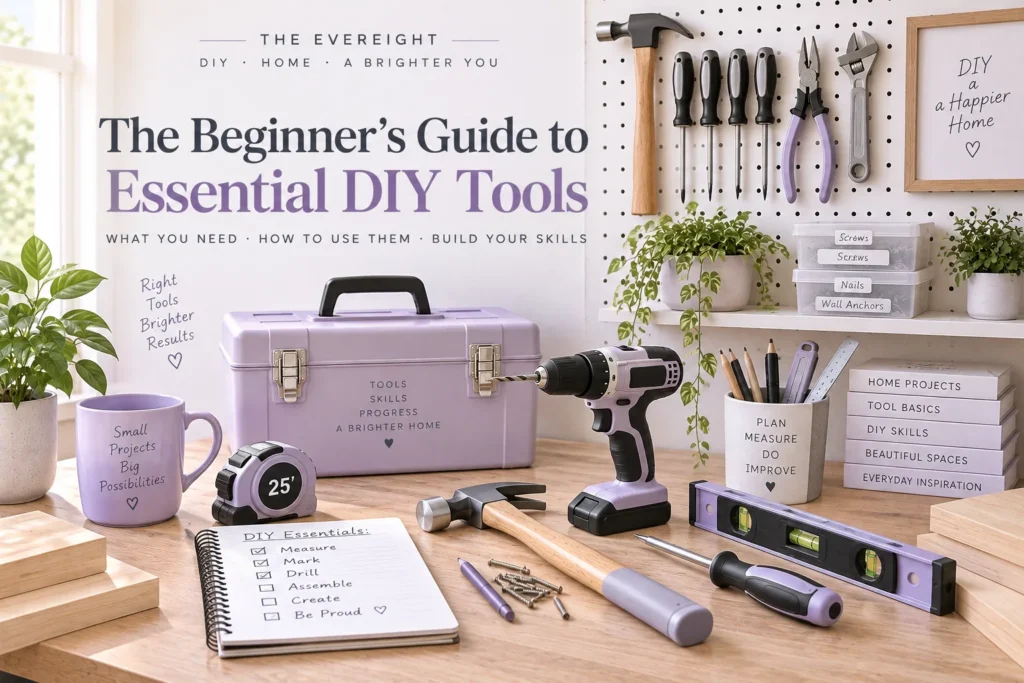
Starting DIY does not require owning a garage full of tools. It requires a small group of reliable tools that match the projects you actually plan to do.
The most useful beginner kit covers five jobs: measuring, marking, fastening, gripping, and making simple controlled changes to materials. Power tools can make some jobs faster, but they also add noise, dust, moving parts, batteries or electricity, and technique. Buy them when a project creates a real need.
This guide explains a practical order of purchase and what to look for without turning a beginner tool list into a shopping checklist.
Quick Answer
Start with a tape measure, pencil, square, level, screwdrivers, adjustable wrench or suitable wrench set, pliers, utility knife used appropriately, hammer, clamps, and basic protective equipment. A drill/driver is often the first power tool worth adding for home DIY. Add saws, sanders, impact drivers, and specialty tools only when your projects justify them.
Tools should be maintained in safe condition, inspected before use, and used for the job they were designed to perform. Guards and other safety features should remain in place. Those principles are consistent with established hand-and-power-tool safety guidance.
1. Tape Measure
A tape measure is useful for furniture placement, hardware spacing, storage projects, lumber, wall layouts, and almost every other DIY category.
For home projects, choose a tape that is comfortable in your hand and easy for you to read.
Do not assume the metal hook is defective because it moves slightly; many tape measures are designed to compensate for inside versus outside measurements. Check the manufacturer’s design if uncertain.
For precision work, use the same measuring tool throughout the project when practical.
2. Pencil and Marking Tools
A standard pencil is one of the highest-value tools you can own.
Use a sharp point for accurate lines. For dark or finished materials, another removable marking method may be appropriate.
Always test whether a marker can be removed before using it on a visible surface.
A good mark tells you not only where the line is, but which side becomes waste.
3. Combination Square or Speed Square
A square helps mark perpendicular lines and check whether parts meet at right angles.
A combination square can also transfer repeated measurements and check depths. A speed square is particularly convenient around lumber and some cutting layouts.
You do not need both immediately.
Choose the style that matches your first projects. If you are still deciding what to make, start with our beginner DIY project guide.
4. Level
A small level helps with shelves, frames, hook boards, cabinets, and other installations.
Longer levels can be easier for wider projects, while compact versions store easily.
Digital features are optional. The important requirement is a reliable tool you understand how to read.
Check the level itself if a result seems suspicious; damaged tools can mislead you.
5. Screwdriver Set
Even if you own a drill, manual screwdrivers remain useful.
They provide control for hardware, switch plates where appropriate, furniture assembly, hinges, and final tightening.
Use the correct tip type and size. A poorly fitting screwdriver can damage the fastener and slip.
Electrical work requires additional knowledge and precautions; owning a screwdriver does not make energized electrical work appropriate for a beginner.
6. Hammer
A general-purpose claw hammer handles common nails and light removal work.
Choose a weight and handle that you can control comfortably.
Inspect the head and handle before use. Do not use a hammer with a loose head, cracked handle, or damaged striking face.
Wear eye protection where flying fragments are possible.
7. Pliers
A basic pair of combination or slip-joint pliers can grip, bend, and hold appropriate materials.
Needle-nose pliers reach small spaces.
Locking pliers can be useful but should not replace the correct wrench or clamp.
Do not use ordinary pliers for live electrical work.
8. Adjustable Wrench and/or Basic Wrench Set
An adjustable wrench is useful when you do not yet own many fixed sizes.
Fit the jaws closely to the fastener to reduce slipping.
For repeated work, correctly sized fixed wrenches or sockets are often more secure and efficient.
Do not use a wrench with damaged jaws.
9. Utility Knife
A utility knife can score cardboard, cut certain sheet materials, open packaging, and trim appropriate materials.
It is also one of the easiest tools to misuse.
Cut away from your body, use a stable surface, retract or cover the blade when not in use, and replace damaged blades safely.
Keep blades secured from children.
10. Clamps
Clamps are an underrated safety and accuracy tool.
They can hold a workpiece while you drill, glue, mark, or assemble so your hands do not have to act as the clamp.
Choose sizes based on your projects.
Use protective pads where clamp jaws could mark a finished surface.
Do not overtighten fragile material.
11. Drill/Driver
For many homeowners, a cordless drill/driver is the first power tool that meaningfully expands what they can do.
It can drill holes and drive appropriate screws using compatible bits.
Useful features may include variable speed, a keyless chuck, clutch settings for screw driving, an LED work light, and a battery platform that fits future needs.
Voltage alone does not determine whether a drill is “better.” Weight, ergonomics, chuck capacity, speed range, battery availability, and the work you plan to do matter.
12. Drill and Driver Bits
The tool is only half the system.
Bits must match the material, fastener, and drill.
A small general-purpose set can cover common wood drilling and screw-driving tasks, but masonry, tile, metal, large holes, and specialty fasteners may require different bits and techniques.
Replace damaged bits.
Do not force the wrong bit through a material.
13. Stud-Finding or Detection Tool – When Wall Work Requires It
A detector can help locate framing or identify some hidden conditions before wall mounting.
But no detector should be treated as infallible.
Walls can contain wiring, plumbing, metal, blocking, and unusual construction. Use the tool according to its instructions and combine it with knowledge of the building.
If the consequences of drilling in the wrong place are serious, investigate further.
14. Basic Saw – Only When the Project Requires Cutting
A beginner does not need to buy a powered saw on day one.
For small cuts, an appropriate hand saw may be enough.
Powered saws can increase speed and repeatability but also increase injury risk. Guards, work support, blade selection, body position, and manufacturer instructions matter.
Choose a saw based on the material and cut, not because it appears on a generic “must-own” list. If you want to see which woodworking skills these tools support, explore our 12 beginner woodworking projects for your home before deciding what to buy.
15. Sanding Tools
A sanding block and sheets of appropriate abrasive are enough for many first projects.
A powered sander can save time on larger surfaces but creates more dust and requires its own safe-use practices.
Dust from wood, coatings, fillers, and sheet materials can be hazardous. Identify what you are sanding and use suitable controls and protective equipment.
Do not sand suspected hazardous legacy coatings casually.
16. Hex Keys and Small Assembly Tools
Many furniture and household products use hex fasteners.
Keep the supplied keys from furniture assemblies in a labeled bag, or own a small quality set.
Use the correct size to avoid rounding the fastener.
These tools are inexpensive and often more useful than a specialized power tool.
17. Putty Knife or Scraper – Used for the Right Material
A flexible putty knife can apply suitable fillers and help with some preparation tasks.
Rigid scrapers have different uses.
Do not scrape unknown old paint without considering hazardous coatings, and do not use a sharp scraper where it can damage glass, stone, or delicate finishes.
18. Flashlight or Work Light
Good lighting improves both accuracy and safety.
A portable work light can reveal pencil marks, surface defects, and dropped hardware.
Position lights so cords do not become trip hazards and the light is appropriate for the environment.
A headlamp can be convenient when both hands are needed.
19. Basic Personal Protective Equipment
PPE depends on the hazard.
Safety glasses are a common starting point for drilling, cutting, and tasks that may create flying debris.
Hearing protection may be needed around loud tools.
Respiratory protection or dust control may be appropriate for dusts, fumes, or coatings, but the correct protection depends on the hazard and product instructions.
Gloves can protect against some materials and sharp edges, but loose gloves can create entanglement hazards around rotating machinery. Follow the tool instructions.
20. A Safe Storage System
Tool storage is part of tool ownership.
Sharp tools should not float loose in a household drawer. Batteries, chargers, blades, chemicals, and accessories should be stored according to manufacturer guidance and away from children where necessary.
A simple toolbox, wall system, or cabinet is enough if tools remain dry, visible, and protected.
What Tools Should a Beginner Buy First?
Tier 1: Almost universal
Tape measure, pencil, square, level, screwdrivers, hammer, pliers, wrench, utility knife, clamps, and basic PPE.
Tier 2: Add for active DIY
Drill/driver, useful drill and driver bits, detection tool for wall projects, sanding supplies.
Tier 3: Project-specific
Saws, powered sanders, specialty clamps, socket sets, hole saws, jigs, and other accessories.
Tier 4: Advanced or infrequent
Routers, planers, nailers, large saws, specialty masonry tools, and other equipment that requires a clear project and appropriate training.
Corded vs Cordless Tools
Cordless tools offer portability and reduce cord management.
Corded tools avoid battery runtime and battery replacement concerns.
Neither is universally superior.
For cordless systems, consider the battery ecosystem before accumulating tools. Batteries are often one of the largest long-term costs.
For corded tools, consider outlet access, extension-cord requirements, and trip management.
Should You Buy a Tool Kit?
A kit can be good value if you will use most of the included tools.
It can be poor value when half the kit duplicates tools you own or contains low-priority items.
Compare the kit against your actual project list.
Article #32 focuses specifically on beginner tool kits.
Buy, Borrow, or Rent?
Buy frequently used basic tools.
Borrow when the tool is safe to share and you understand how to use it.
Rent expensive specialty tools for occasional projects, particularly when the rental source provides appropriate instructions and the equipment is maintained.
Do not rent an advanced tool simply to avoid hiring a professional for work beyond your skill level.
How Much Should a Beginner Spend?
There is no required amount.
A careful collection built project by project is often better than one large purchase.
Spend on:
- Safe construction.
- Comfortable control.
- Appropriate specifications.
- Replaceable consumables.
- Warranty and service where relevant.
Do not pay for features you cannot explain how you will use.
Tool Safety Basics
Inspect tools before use.
Use the correct tool and accessory for the job.
Do not remove or defeat guards or safety devices.
Secure workpieces appropriately.
Disconnect power or remove the battery where the manufacturer instructs before changing accessories or servicing.
Keep the work area lit and controlled.
Read the manual, especially for a new power tool.
If a tool is damaged or behaving unexpectedly, stop using it.
Editorial Note
Our tool guides are based on independent research and practical evaluation criteria. We aim to help readers understand what specifications matter before they buy. Product features, bundles, warranties, prices, and availability change, so verify current manufacturer information before purchasing.
EverEight Pro Tip
Create a tool wish list with a project written beside every item. If you cannot name the next project that needs a tool, leave it on the list. This single rule prevents a beginner workshop from becoming expensive storage.